



Wiltson IFR18650: An 18650 Cell Built for Real Cold
Wiltson IFR18650: An 18650 Cell Built for Real Cold
Senior Battery Engineer, Wiltson Energy
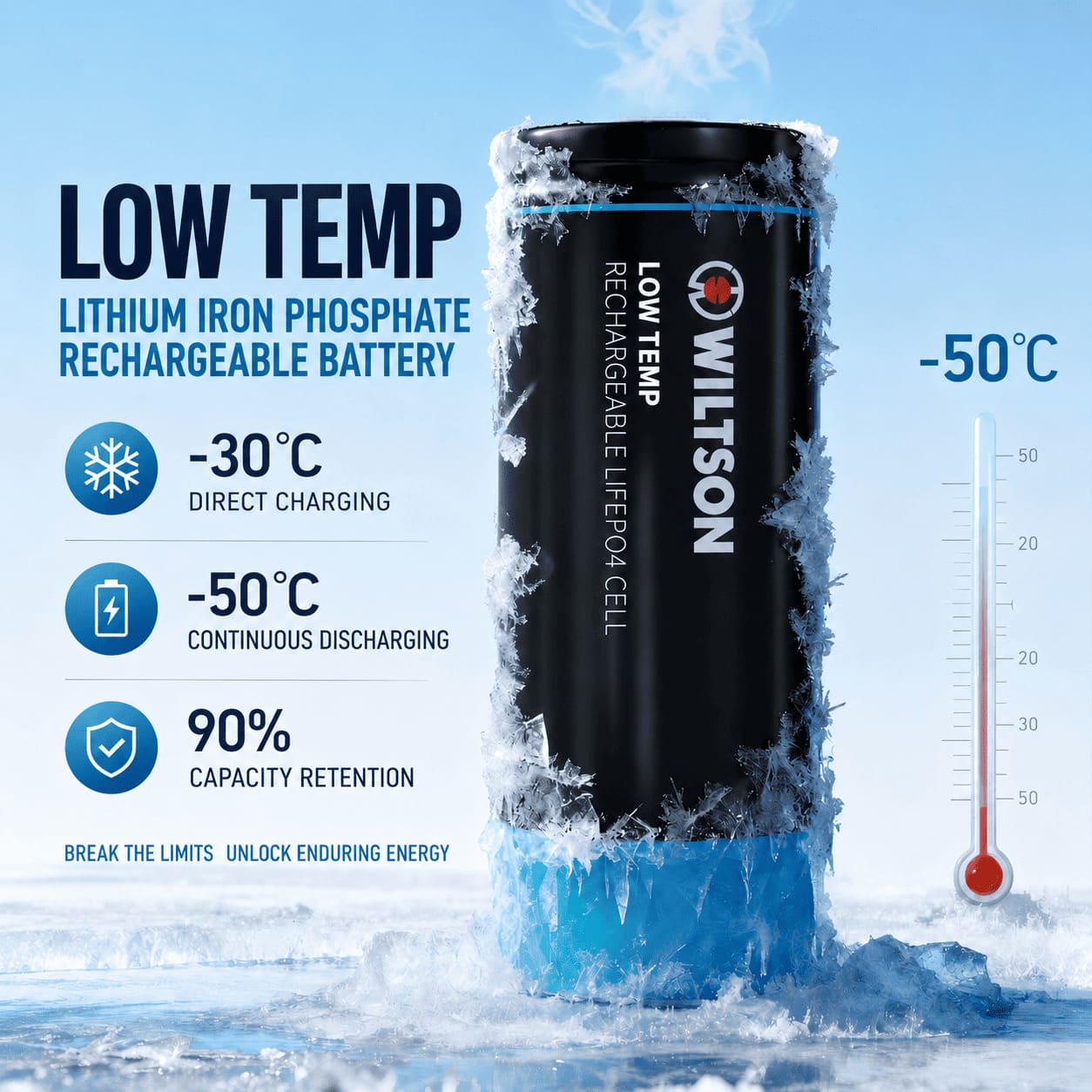
Engineers who design systems for off-grid solar, cold-climate mobility, and remote industrial backup know the problem: drop the temperature far enough and most lithium-ion cells lose capacity fast. Charging becomes unreliable or risky. In northern Canada, the Nordic countries, Alaska, and other cold regions, that can shut down an installation when power matters most.
The Core Claim
Wiltson Energy's IFR18650 is an LFP 18650 cell built for cold operation: discharge down to -50°C, charge down to -30°C, and a standard 18650 mechanical format for pack integration.
The value is simple. Instead of designing around a cell that becomes dead weight in winter, you can evaluate a lithium iron phosphate cell that keeps delivering usable power through long freezing nights.
Why Cold Changes the Battery Decision
A cold-weather battery is not only a datasheet problem. It affects charging access, pack safety, field maintenance, and whether a remote system survives the worst week of the year.
Charging Stops First
Many lithium systems become difficult to charge in sub-zero weather. The IFR18650 is specified for charging down to -30°C, reducing the need for heater-first charging logic.
Runtime Becomes Site Risk
If a battery bank sits idle during a freezing night, the load still needs power. Discharge capability down to -50°C gives designers more room in remote sites.
Safety Still Matters
Cold performance cannot come at the cost of abuse tolerance. The source article lists short-circuit, over-charge, over-discharge, thermal abuse, drop, vibration, and temperature shock testing.
IFR18650 Specifications from the Source Article
These are the product details stated in the provided Markdown source. For final engineering approval, request the full Wiltson datasheet and test reports before locking pack design.
Cell Data
| Parameter | Wiltson IFR18650 | Why It Matters |
|---|---|---|
| Chemistry | LFP / LiFePO4 | Thermal stability is central for packs near equipment or people. |
| Nominal capacity | 1500 mAh | Minimum capacity is listed as 1400 mAh at 0.2C. |
| Nominal voltage | 3.2 V | Matches typical LiFePO4 pack voltage planning. |
| Energy density | Around 128 Wh/kg | Useful for weight-sensitive pack layouts. |
| Continuous discharge | 3C in a well-designed pack | Pack design and thermal path still control the final limit. |
| Charge temperature | -30°C to +45°C | Supports winter charging without relying first on external heating. |
| Discharge temperature | -50°C to +60°C | Targets harsh outdoor and remote equipment sites. |
| Dimensions | 18.3 ± 0.2 mm x 65.3 ± 0.5 mm | Keeps the familiar 18650 mechanical envelope. |
| Weight | About 42 g | Helps estimate pack weight early in design. |
Source: provided Markdown article and Wiltson Energy product claims referenced inside that article.
Built for Packs That Cannot Wait for Warm Weather
The IFR18650 is useful when the battery is not sitting in a comfortable indoor cabinet. Think pole-mounted solar storage, exposed telecom boxes, winter mobility packs, and equipment that has to wake up after a cold night.
Wiltson Energy states that the cell has passed short-circuit, over-charge at 10 A / 10 V, over-discharge, 130°C thermal abuse, drop, vibration, and temperature shock tests with no fire, no explosion, and no leakage. That abuse-test profile matters for packs installed in hard-to-reach locations.
Design Note for Pack Engineers
The cell specification is only the starting point. For a real pack, confirm BMS low-temperature logic, current limits, cell matching, enclosure heat flow, and connector behavior. A 3C discharge claim still depends on a well-designed pack, not only the cell can.
Ask for the full datasheet, abuse-test report, and low-temperature charge/discharge curves before pilot production.
Where This Cell Fits Best
The strongest fit is not every 18650 project. It is the project where low temperature creates field failures, truck rolls, support tickets, or conservative over-sizing.
- Off-grid solar, wind, and micro-grids — Storage stays useful through winter instead of becoming idle mass during freezing nights.
- E-bikes, last-mile delivery, and light EVs — Winter reliability matters when fleets and riders cannot pause operations for battery temperature.
- Industrial backup, telecom, and automation — Fewer site visits and less downtime in exposed enclosures or remote cabinets.
- Marine, RV, and outdoor equipment — Packs face large temperature swings and need stable behavior across seasons.
FAQ
1. How cold can the Wiltson IFR18650 operate? ▼
The cell is specified for discharge from -50°C to +60°C and charging from -30°C to +45°C. That makes it a candidate for cold-climate projects that cannot depend on battery heaters before every charge cycle.
2. What chemistry does the IFR18650 use? ▼
It uses LFP, also known as LiFePO4, chemistry. The article emphasizes LFP's thermal stability and Wiltson's abuse-test validation for packs deployed near people, equipment, or hard-to-service sites.
3. Can this cell fit existing 18650 mechanical designs? ▼
Yes. The stated dimensions are 18.3 ± 0.2 mm in diameter and 65.3 ± 0.5 mm in height, with a weight of about 42 g. That keeps the cell close to the standard 18650 format.
4. What safety tests are listed? ▼
The source article lists short-circuit, over-charge at 10 A / 10 V, over-discharge, 130°C thermal abuse, drop, vibration, and temperature shock tests. The reported result is no fire, no explosion, and no leakage.
5. How should buyers evaluate samples? ▼
Start with your true minimum ambient temperature, charge window, peak current, and enclosure design. Then request samples, the full datasheet, test reports, and low-temperature curves from Wiltson Energy before freezing the pack layout.
Conclusion
The IFR18650 is worth evaluating when cold weather is not a corner case. Its headline values are clear: 1500 mAh nominal capacity, 3.2 V nominal voltage, discharge down to -50°C, and charge down to -30°C.
For B2B pack builders, the next step is practical rather than theoretical: test the cell against your exact load profile, enclosure, and cold-start requirement. If the numbers hold under your conditions, you may be able to reduce heater dependence, simplify winter pack design, and keep remote systems working when service access is limited.
Need IFR18650 Data for a Cold-Climate Pack?
Request samples, datasheets, low-temperature curves, and pack integration support from Wiltson Energy.
Request IFR18650 Cell DataEmail: sales@wiltsonenergy.com | Tel: +86-769-8100-7293 | Website: www.wiltsonenergy.com