



Why Standard LFP Stops at 0°C (And the IFR18650 Doesn't)
Cold Charging Works. — Just Not in Every Battery.
Senior Battery Engineer, Wiltson Energy
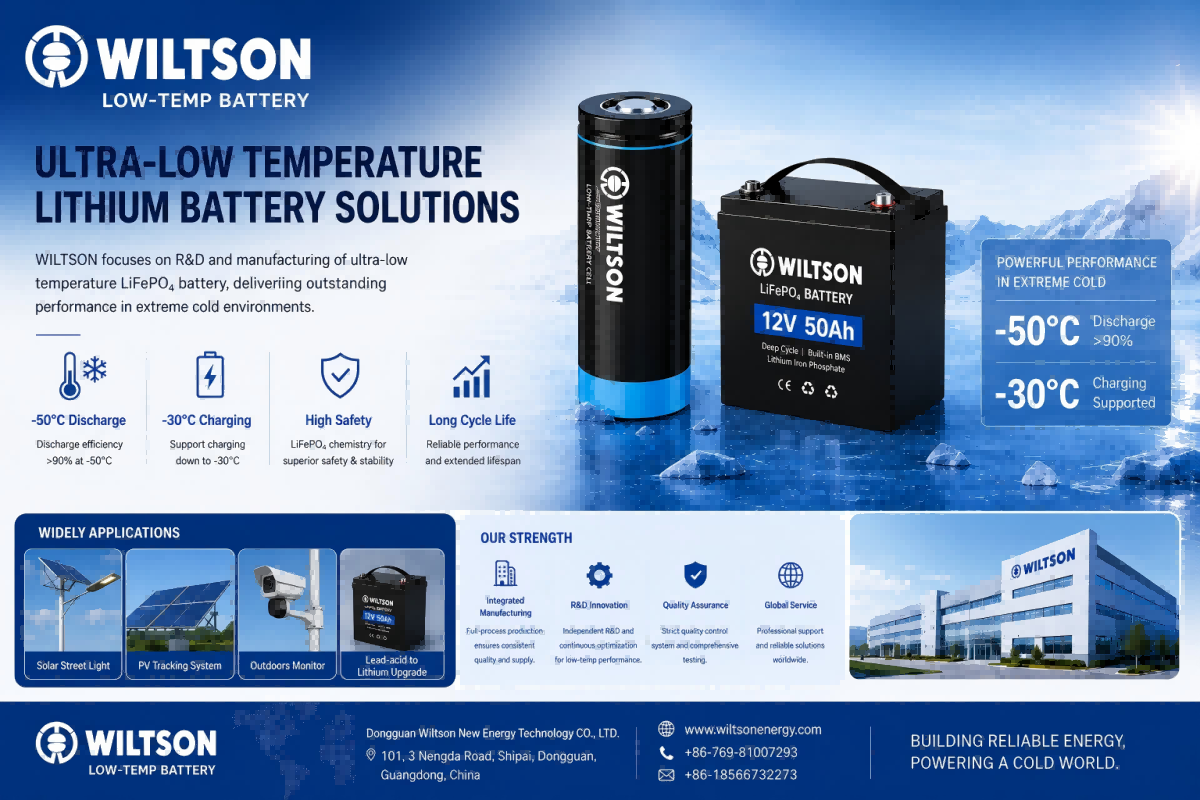
Standard lithium batteries lock out charging below 0°C. The Battery Management System (BMS) does this to prevent permanent damage from lithium plating. It is the correct behavior for standard cells.
The Wiltson Energy IFR18650 sets the BMS charge-enable threshold to −30°C. It keeps discharge capability down to −50°C. No external heater. No warmup required.
Key Specs at a Glance
- • Standard LFP: BMS disables charging below 0°C — correct protection, not a fault
- • Wiltson IFR18650: charges −30°C to +45°C, discharges −50°C to +60°C
- • Cold capacity: ~85% at −20°C / ~70% at −30°C / ~55% at −40°C
- • Cold-charge current reduced at extreme temperatures — matched to winter solar input
- • Cycle life: 2,000+ cycles (room temp); ~1,500 cycles at −20°C with cold-charge protocol
You need the IFR18650 if: your charging window is below −10°C and your power source is solar or intermittent. Not for grid systems with temperature-controlled warmup.
The Physics of Why Standard LFP Stops at 0°C
In standard cells, ion movement drops sharply below 0°C. That drop triggers a second failure mode — more damaging than slow charging.
Ion Movement Collapses
In standard cells, ion movement drops sharply below 0°C. The exact drop depends on the cell's chemistry. But it is big enough to make safe charging impossible.
Lithium Plating Begins
When current enters a cold graphite anode, lithium ions deposit on the surface as metallic lithium instead of inserting into the lattice. Each deposit permanently consumes active lithium and raises resistance.
The Damage Does Not Reverse
In severe or repeated cases, metallic deposits can form structures that may touch the separator. The BMS disables charging at 0°C to prevent this. It works — for standard cells within their design window.
Cold Performance by the Numbers
The modified cell fluid keeps ion flow high enough for safe lithium insertion — at temperatures where standard cells cannot accept any charge.
Standard LFP vs. Wiltson IFR18650
| Parameter | Standard LFP | Wiltson IFR18650 |
|---|---|---|
| Min. charge temperature | 0°C | −30°C |
| Min. discharge temperature | −20°C | −50°C |
| Capacity at −20°C | 40–60% | ~85% |
| Capacity at −30°C | <20% | ~70% |
| Capacity at −40°C | ~0% | ~55% |
| Cycle life at −20°C | 800–1,200 | ~1,500 |
Discharge at 0.2C rate, standard LFP voltage floor cutoff, cells maintained at indicated temperature throughout cycle. Capacity expressed as percentage of rated capacity at 25°C.
Material Science vs. Heating Pads: Why Chemistry Wins
The Wiltson IFR18650 uses a modified electrolyte with lower-viscosity solvents and interface-stabilizing additives. At −30°C, a standard carbonate electrolyte gets so thick that lithium ions move too slowly for safe insertion into the anode. In the IFR18650, ion mobility stays sufficient.
We also tune the SEI (Solid Electrolyte Interphase) chemistry for cold stability. This boosts ion flow and cuts interface resistance — the two bottlenecks that shut down standard cells. Heating pads address the symptom. Modified electrolyte removes the constraint entirely. For off-grid solar, that eliminates a 10–30% energy penalty that would otherwise warm cells before the sun can help.
Real-World Proof: 340 Packs in Xinjiang
Wiltson Energy field data from 340 telecom battery packs in Xinjiang (2024–2025) documents consistent winter performance in environments with 30–40°C daily temperature swings — among the most demanding thermal profiles for any battery deployment.
No heating infrastructure. No early replacements. Cycle life at −20°C: ~1,500 cycles to 80% capacity, charging at 0.1C during cold phases. One cycle per day. Four-plus years before replacement.
Engineering Constraint: IFR18650 BMS Charge Map vs Standard LFP
| Parameter | Standard LFP | Wiltson IFR18650 |
|---|---|---|
| Charge enable threshold | 0°C | −30°C |
| Cold-charge current (−30°C to −10°C) | N/A — charging disabled | 0.1C (10A per 100Ah) |
| Normal charge current (above −10°C) | Standard rate | Standard rate |
| Discharge cutoff | −20°C | −50°C |
A 200W panel at 55°N in January delivers 100–150W after sun angle, derating, and MPPT losses — approximately 8–12A at 12.8V. This falls inside the 0.1C window for most off-grid system sizes. No extra design work needed.
When to Specify the IFR18650
Two scenarios. Opposite answers.
- Charging occurs below −10°C — solar, wind, or intermittent sources where cells may be cold when charging starts
- No grid warmup available — off-grid or remote installations with no path to warm cells before charging
- 3+ year field life required — sub-zero environments where standard LFP cycle life falls short
Standard LFP is the right call when:
- All charging happens above 0°C — indoor installations, heated enclosures, or temperature-controlled battery rooms
- Cold use is discharge-only (cells charged warm, then deployed into cold)
- Grid power is available with a temperature-triggered charge delay
FAQ
1. Can these batteries actually charge at −30°C? ▼
Yes. The BMS charge-enable threshold is −30°C. Limit the charging current to 0.1C from −30°C to −10°C. Above −10°C, full charge current resumes.
2. What happens if I charge standard LFP below 0°C? ▼
The BMS blocks it. Override the BMS, and lithium plating starts immediately — permanent capacity loss, rising resistance. It does not reverse.
3. Is 0.1C slow charging a problem for solar systems? ▼
Not typically. Winter solar output at northern latitudes falls inside the 0.1C window for most system sizes. Panel and battery are naturally matched — no extra design work needed.
4. How does this compare to a heating pad approach? ▼
Heating pads burn 10–30% of battery energy before charging starts. In deep winter, that draw stops the battery from reaching full charge. IFR18650 cells carry no heating overhead — the panel charges the load, not the heater.
5. What safety testing has the IFR18650 passed? ▼
We test every cell for short-circuit, overcharge (10A / 10V), over-discharge, thermal abuse (130°C), drop, vibration, and temperature shock. No fire, no explosion, no leakage — under any condition. Request UN38.3 certification and full test reports from your sales contact. For thermal cycling testing at your site's Delta-T range, reach out to the engineering team.
6. What is the minimum configuration for a custom pack? ▼
Send your temperature range, capacity (Ah), and charge source (solar/grid/hybrid). We configure BMS thresholds, current maps, and thermal monitoring to your site. Lead time: 4–6 weeks from spec confirmation.
Conclusion
Charging below 0°C is not a lithium problem. It is a standard-cell problem. The IFR18650 solves it at the chemistry level — modified electrolyte, tuned SEI, expanded BMS window. No workaround. No heating penalty.
For engineers specifying off-grid solar, remote telecom, or industrial outdoor installations that charge below −10°C, the IFR18650 removes the constraint that forced heating systems in the first place. The rule "lithium batteries cannot charge below 0°C" still applies to standard cells. It does not apply here.
Ready for Cold-Weather Performance Without the Heater?
Send your temperature range, charging source, and target life. Discharge curves at your exact temperatures back within 48 hours.
Request IFR18650 Data SheetEmail: sales@wiltsonenergy.com · Tel: +86-769-8100-7293 · wiltsonenergy.com