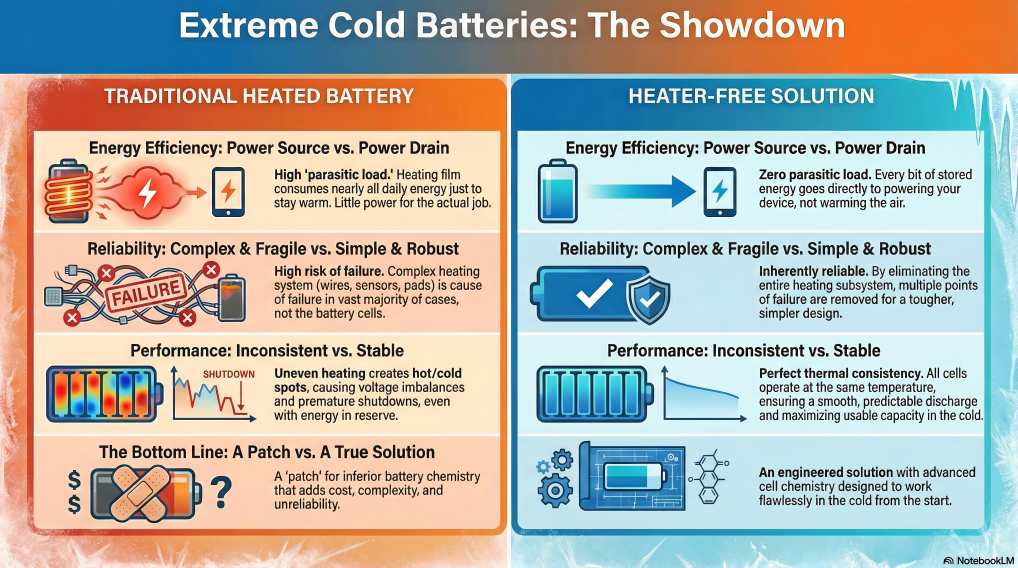
In extreme cold, the industry default logic is simple: "If the battery is cold, put a jacket on it or light a fire."
This thinking has led to the widespread use of heating films in traditional low-temperature lithium battery designs. However, after in-depth discussions with hundreds of clients operating in high-latitude and high-altitude regions, we have uncovered a harsh reality:
Trying to heat a battery in -30°C (-22°F) winds is like running a space heater with the windows open. It is not only a massive waste of energy but also a primary source of system failure.
If you are deploying solar street lights, remote monitoring stations, or high-latitude logistics equipment, this article explains why the Heater-Free Strategy is the ultimate solution for extreme cold.
1. The Energy Math: Is Your Battery a Power Source or a "Hand Warmer"?
For off-grid applications—especially solar street lights—the winter Energy Budget is unforgiving.
One of our senior account managers shared a revealing case study from a project in Inner Mongolia. In that region, winter daylight is scarce, and the solar panels could only generate approximately 120–150 Wh of power per day.
The client was originally using a standard battery equipped with heating films. They discovered that once the temperature dropped below -20°C, the heating film was active almost 24 hours a day just to maintain a chargeable temperature.
Lighting Demand: A 20W LED light requiring 160 Wh per night.
Heating Consumption: A 10-15W heating film consuming 100-150 Wh per day.
The math is brutal. The solar panel’s entire daily output was being eaten alive by the heating film.
"I feel like I didn't buy a street light; I bought a 'battery warmer.' The heater ate all the power, and the light only stayed on for 3 hours."
This is a classic case of Parasitic Load. With the Wiltson Heater-Free solution, we drive this parasitic loss down to zero. Every single milliamp-hour (mAh) goes to the load—lighting the street, not heating the air.
2. Complexity Equals Fragility: 90% of Failures Come from "The Patch"
Many engineers assume heating systems are a "mature" technology. However, our RMA (Return Merchandise Authorization) data tells a different story.
When we tear down "failed" battery packs returned by clients using competitor solutions, we find a shocking statistic: In the vast majority of cases, the battery cells are fine; the heating system is what failed.
Our Technical Director summarizes the three main causes of death for heating-based solutions:
NTC Thermistor Failure (90% of cases): If the temperature probe drifts or fails, the BMS misreads the environment. The result? The heater runs indefinitely, "cooking" the battery to 70°C+ and causing bloating or thermal runaway.
Short Circuits from Uneven Heating: Cheap heating films often lack thermal uniformity. If applied unevenly, "hot spots" occur, melting the separator and causing internal shorts.
Wire Harness Embrittlement: At -30°C, standard PVC insulation on the complex heating wiring becomes as brittle as glass. Vibration from wind or vehicles causes the wires to snap.
"Adding a heating system isn't just a cost issue; it's a probability issue. Every relay, every wire, and every probe you add is a new Single Point of Failure."
3. The Technical Truth: The Invisible Killer Called "Thermal Inconsistency"
Beyond explicit failures, heating solutions suffer from an invisible, fatal flaw: Thermal Inconsistency.
Imagine a battery pack with dozens of cells. The heating pad is applied to the surface. This creates a gradient:
Cells near the heater: Warm up fast, internal impedance drops.
Cells far from the heater: Remain cold, internal impedance stays high.
During discharge, this temperature delta causes severe voltage inconsistency. The BMS detects the low voltage of the cold cells and cuts off power prematurely—even though the pack still has plenty of energy left.
How does the Wiltson Heater-Free solution solve this?
Our Low-Temp Battery are engineered to retain 70-75% of their nominal capacity at -30°C with a smooth discharge curve.
"This is made possible by our proprietary low-viscosity modified electrolyte, which maintains an ionic conductivity at -30°C that is 5 times higher than standard electrolytes, thereby avoiding the surge in internal resistance that paralyzes ordinary batteries."
Because no external heating is required, there is no temperature gradient. All cells operate at the exact same temperature, maintaining perfect voltage consistency and system stability.
4. Customer Evidence: The "Aha!" Moment Worth 12% in Savings
If heater-free solutions are superior, why do people still use heating pads? Usually, it’s just inertia. But once clients switch, they never look back.
A logistics equipment manufacturer in the Nordics was one of our toughest prospects. They were convinced that their automated guided vehicles (AGVs) could not run in -25°C cold storage without heaters. To prove them wrong, we conducted an A/B test:
Option A: Their original heating-based battery.
Option B: The Wiltson Heater-Free Low-Temp solution.
Two weeks later, the data made the decision for them:
Simplified Architecture: The heating films, thermal harnesses, and control modules were eliminated, reducing component count by 50%.
Cost Reduction: The total Bill of Materials (BOM) cost dropped by 12%.
Reliability: System alarms dropped from 4-6 times per month to Zero.
"I finally realize that a battery should just work in the cold. I’m never touching heating pads again—that’s just a 'patch' for manufacturers with inferior cell chemistry."