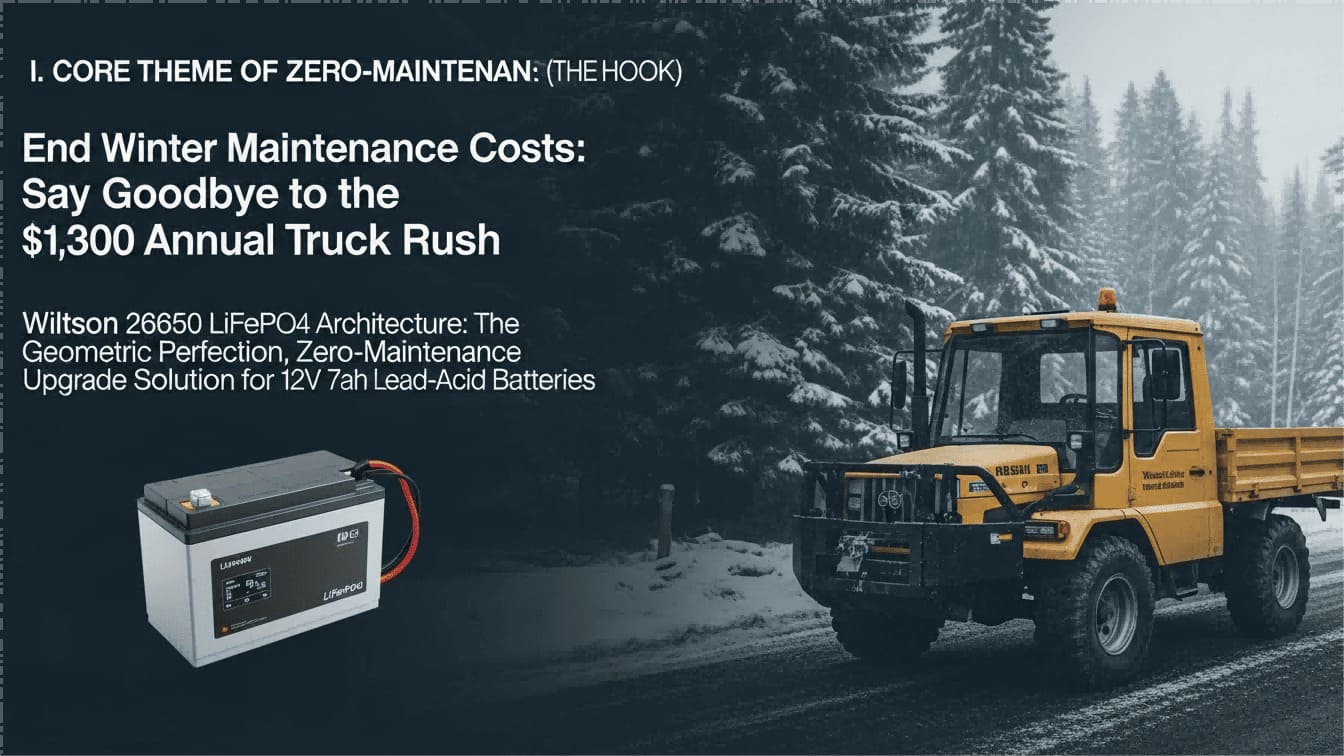
For engineers managing outdoor traffic signals, remote monitoring boxes, or portable medical kits, the 12V 7Ah Sealed Lead-Acid (SLA) battery has long been the standard. It’s cheap, standardized, and readily available.
But in high-latitude regions, that $25 battery is likely costing you over $1,300 per winter in hidden maintenance fees.
At Wiltson Energy, we have analyzed the Operational Expenditure (OpEx) data from dozens of municipal and industrial clients. The verdict is clear: In extreme cold, relying on SLA—or trying to patch it with heating pads—is mathematically unsustainable.
This article breaks down the "Invisible Maintenance Costs" and explains why the 26650 LiFePO4 architecture is the only geometrically perfect, zero-maintenance upgrade for the 12V 7Ah form factor.
1. The Math: Why a $25 Battery Costs $1,300 to Maintain
It is a common scenario: A solar-powered traffic light works fine in October. But by January, with temperatures dropping to -20°C (-4°F), the battery fails. You send a truck. It happens again two weeks later.
We modeled this cost using 2024/2025 industry benchmarks. The results are shocking.
The "Truck Roll" Calculator:
Let’s assume a typical 5-month winter season where a frozen SLA battery forces a site visit just twice a month.
Labor Cost:According to the U.S. Bureau of Labor Statistics, the average loaded hourly wage for a field technician is approx. $27/hr [1]. A typical trip takes 3 hours.Cost: $81.00 per visit.
Logistics Cost:Based on the IRS Standard Mileage Rate (2024) of $0.67/mile [2], a 40-mile round trip adds significant expense.Cost: $26.80 per visit.
The "Cheap" Battery:Replacement battery cost: ~$25.
The Total Winter Bill
($81 + $26.80 + $25) × 10 Visits = $1,328.00
Conclusion: You are paying 50 times the cost of the battery just to keep it running. Upgrading to a lithium solution that requires zero winter visits pays for itself in the first month.
2. The Physics: Why Lead-Acid Enters a "Death Spiral"
Why do SLA batteries fail so consistently in the cold? It is not just "bad luck"; it is chemistry.
Lead-acid batteries rely on liquid electrolyte diffusion, which slows dramatically as temperatures drop. According to data from Battery University, at -18°C (0°F), a standard SLA battery delivers only ~50% of its rated capacity [3].
The "Death Spiral" Mechanism:
Capacity Drop: The battery effectively shrinks from 7Ah to 3.5Ah overnight.
Solar Deficit: The shortened winter day cannot fully recharge the battery.
Freezing: A partially discharged lead-acid battery has an electrolyte that is closer to water. It freezes, expands, and cracks the internal plates. This damage is irreversible.
3. The "Heater Myth": Why You Can't Just Heat an SLA
Some engineers attempt to fix this by adding a silicone heating pad to the lead-acid battery. Mathematically, this is a trap for small solar systems.
Let’s look at the energy budget:
A standard 12V silicone heater draws 10W to 15W [4].
To keep a battery warm in a -20°C night, the heater may run for 24 hours.
Energy Consumed: 10W × 24h = 240Wh.
The Problem: In winter, a small 50W solar panel might only generate 150Wh of usable energy per day.
The Result: The heater consumes 100% of the solar generation plus the battery's reserves. The system dies faster with the heater than without it.
4. The Geometric Solution: The 26650 LiFePO4 Advantage
If SLA fails and heaters don't work, what is the alternative?
The challenge has always been dimensions. A standard 12V 7Ah case measures 151mm × 65mm × 94mm.
18650 Cells: Require complex arrays (e.g., 4S3P or 4S4P) to match capacity, wasting space on plastic holders and BMS wiring.
32700 Cells: Too large to stack efficiently in this specific enclosure.
Enter the 26650 Cell.
The 26650 LiFePO4 cell (approx. 26.2mm diameter × 65.6mm height) is the "Golden Ratio" for this form factor.
Perfect Fit
4 cells (4S1P) or 8 cells (4S2P) fit perfectly inside the standard SLA footprint.
Because we use cylindrical 26650s instead of soft-pack pouch cells, the structural integrity is higher, and the cells are naturally more resistant to vibration—critical for portable traffic lights and road equipment.
5. ROI Comparison: The 5-Year Outlook
Why switch to Wiltson's 26650 solution? The Return on Investment (ROI) is immediate.