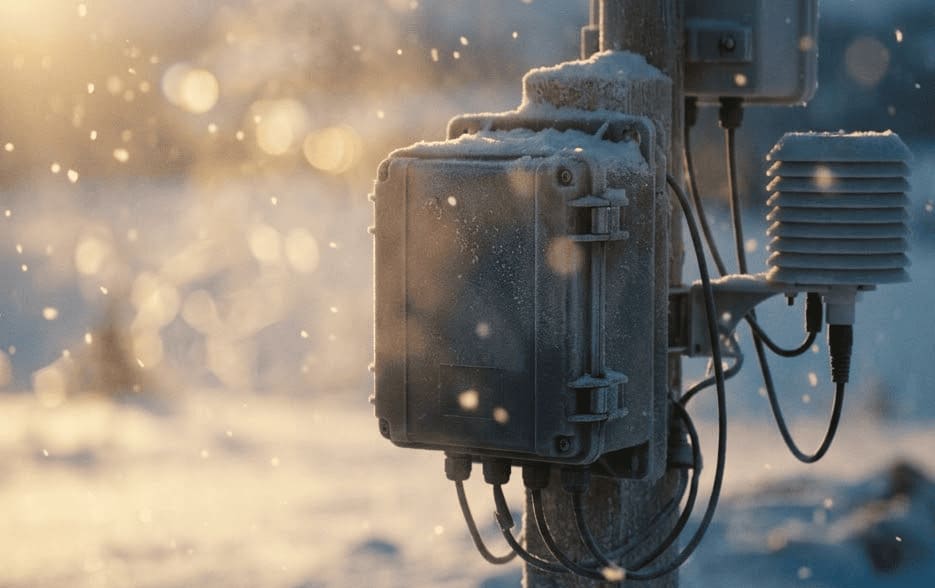
The station had been logging data through three winters without a problem. Then February arrived, temperatures dropped to -22°C, and the unit went silent. The sensors were fine — wind speed, temperature, barometric pressure, all rated to -40°C. The problem was the 12V sealed lead-acid battery that powered them.
It had delivered its last ampere-hour sometime during the night, and no one knew until the morning call log showed a 14-hour gap in data.
This is the most common failure mode in cold-climate Automatic Weather Stations (AWS), and it happens for a reason the spec sheet won't explain.
The Spec Sheet Problem
Most automatic weather stations list an operating temperature range for their sensors. A professional-grade anemometer might be rated to -40°C. The tipping bucket rain gauge, -30°C. The data logger enclosure, -40°C. These numbers are real and tested.
What the spec sheet rarely lists is the operating temperature range of the rechargeable battery powering all of it.
Example: Vaisala RWS200
Look at a benchmark professional road weather station. The unit operates at -40 to +60°C without battery backup. Add the 28 Ah backup battery, and the range drops: -40 to +50°C. The battery constrains the system. No manufacturer discusses what happens to that 28 Ah figure at -20°C.
✦Sealed Lead-Acid: A 24 Ah SLA battery delivers roughly 12 Ah at -20°C.
✦Standard LFP: Stops accepting charge safely at 0°C unless it has a dedicated heating circuit.
✦NiMH: Manages only ~50% capacity at -10°C and 20% at -20°C, and cannot recharge below freezing.
Your sensors are cold-rated. Your battery is not.
The Double Squeeze
The capacity problem is only half the story. In cold weather, your station runs a simultaneous deficit on both sides of the energy equation.
Demand Side: Spikes
Heated sensors consume substantially more power. A heated tipping bucket, heated anemometer, heated pyranometer — each draws continuous current to prevent ice. Winter power consumption can be two to three times the summer baseline.
Supply Side: Collapses
Solar harvest collapses exactly when you need it most. At latitudes above 50°N, December/January provide 0.5–1.0 peak sun hours per day. Sites above 60°N may go days without enough irradiance to recharge.
Your battery carries the station through 18-hour winter nights. It starts each dawn at a lower state of charge than the night before. Cold has already cut its deliverable capacity in half — the math compounds against you faster than any summer worksheet predicted.
This is why remote stations go dark during blizzards. Because the power system was sized for a different season.
Chemistry Comparison for Cold-Climate AWS
How standard backup options behave at the extremes.
Chemistry
Discharge to -40°C
Charge below 0°C
Rechargeable
Typical Issue
Standard LFP
~40–60% capacity
Blocked (plating risk)
Yes
BMS cuts charging at 0°C; heating required.
Sealed Lead-Acid
~50% at -20°C; freezes at -27°C
Slow, requires temp comp
Yes
Weight, severe capacity loss, physical freeze risk.
NiMH
~20% at -20°C
Blocked below 0°C
Yes
Worst cold capacity; prohibits solar recharge in winter.
Primary Lithium
>90% to -40°C
Not applicable
No
Excellent performance but cannot be solar-recharged.
Only viable rechargeable option for extreme cold without a heater.
Primary lithium cells discharge well in cold but cannot be solar-recharged — not a solution for unattended AWS. The standard LFP answer — adding an internal heater — is circular: you consume stored energy to allow more energy to be stored. At sites where the solar deficit is already severe, this loop fails before spring.
Choosing a Cell That Matches the Sensor Spec
The correct specification: the rechargeable battery should charge at the same minimum temperature as the sensors it powers. If your anemometer is rated to -30°C, the battery needs to accept a charge at -30°C. Not with a heater. Natively.
The Native Advantage
Native cold-tolerant LFP cells differ from everything else in the table. Through changes to electrolyte composition and anode material, they maintain charge acceptance at -30°C and discharge capacity above 90% at -40°C. The solar recharge cycle runs on every available sun-hour, even at -25°C, without keeping the battery warm first.
Wiltson's LT series cells are one example: rated for charging down to -30°C and discharge to -50°C. For solar-powered AWS, the relevant advantage is the charge number. A battery that recharges at -30°C means every hour of weak January sun contributes instead of being wasted.
Sizing for the Worst Week
Even with the right chemistry, size for the worst case, not the average.
1
Calculate winter peak consumption
Add sensor heater loads + logger draw + telemetry current. A heated anemometer draws 20–40 W.
2
Find minimum solar harvest
Use monthly insolation data (NASA POWER), not annual averages.
3
Calculate the energy deficit
Subtract daily solar harvest from daily consumption. The battery must carry this across cloud events.
4
Apply the cold derating factor
Standard LFP/SLA: divide nameplate by 2 at -20°C. Low-temp LFP: apply ~10% derating.
Before the Next Winter
✓
Find the battery spec
If it says 0°C minimum charge, your solar recharge stops at 0°C — regardless of your sensor's -40°C rating.
✓
Run the winter power budget
Use worst-case solar hours and worst-case consumption with all heaters active.
✓
Match battery to sensor spec
A sensor rated to -40°C paired with a battery that stops charging at 0°C is just a 0°C system with expensive sensors bolted on.
Frequently Asked Questions
Why does my weather station lose data overnight in winter when the battery looks charged?▼
Cold reduces deliverable capacity — a battery showing "charged" at -20°C may deliver only 30–40% of rated energy. If overnight draw plus morning heater activation exceeds what the cold-derated battery can supply, the station shuts down.
Can I just add a battery heater to a standard LFP system?▼
You can, but in solar-deficit winter conditions, the heater draws from the battery — sometimes more than the panel recovers. At sites above 55°N in December, this creates a net-negative energy loop.
What is the minimum solar panel size for an AWS at 60°N in winter?▼
At 60°N in December, you may have 0.3–0.6 peak sun hours per day. A 20W panel delivers roughly 0.5–1.0 Ah at 12V daily. Most heated AWS systems consume 10–50 Ah/day. Battery bank size is the critical variable.
Is LiFePO4 better than lead-acid for cold-climate weather stations?▼
Standard LFP outperforms lead-acid in cycle life but shares the same 0°C charging cutoff. Lead-acid adds freeze risk at -27°C when discharged. Low-temperature LFP is the better choice for unattended installations.
How do I find winter peak sun hours for my weather station site?▼
NASA POWER (power.larc.nasa.gov) provides monthly insolation data for any coordinate. Check December and January figures at your latitude's optimal tilt — use that number, not the annual average.
Eliminate the Winter Data Gap
The data gap in the log is always avoidable. It just requires asking a different question of the spec sheet before installation — not after the blizzard.