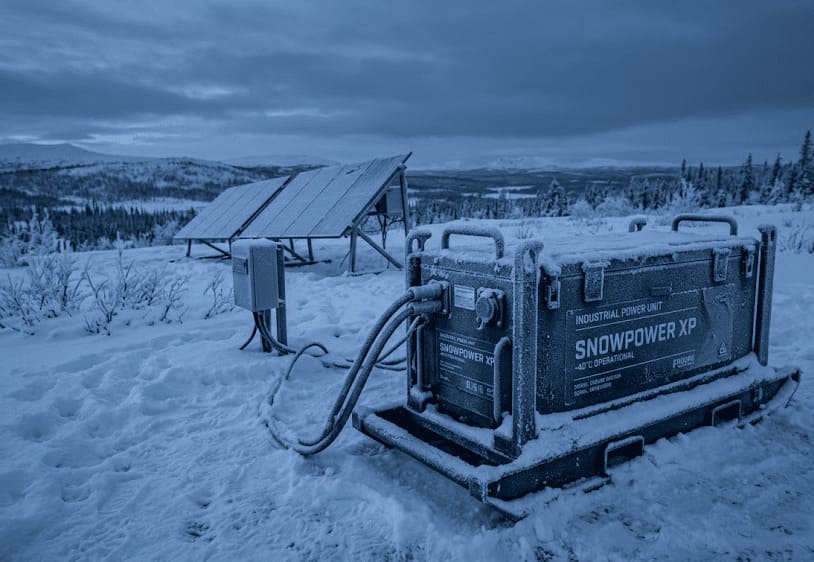
Search "low temperature batteries" and you will find the same article written fifty times. Cold reduces capacity. Lithium plating is dangerous. Keep your battery warm. Insulate the enclosure.
None of those articles answer the question you actually have: which chemistry, at what cost, for how long, under your specific deployment conditions.
This article compares seven battery chemistries at three sub-zero temperature points with measured performance data. It calculates the real energy cost of heated battery packs versus native low-temperature chemistry. It provides a five-year total cost of ownership framework for a 50-station deployment. And it ends with a decision matrix that maps your site conditions to a specific chemistry recommendation.
Why Batteries Fail Below Zero: Three Mechanisms, Not One
Cold does not simply "reduce performance." Three distinct electrochemical failure mechanisms operate simultaneously. Understanding which mechanism dominates at your operating temperature determines which chemistry survives.
1
Electrolyte Viscosity
As temp drops, the organic solvent thickens. At −40°C, ionic conductivity drops to 10–30% of room-temperature value. The battery discharges, but voltage sags heavily. This is behind every "capacity at −20°C" spec you read.
2
Lithium Plating (Charging)
When lithium ions arrive at the anode faster than it can absorb them, metallic lithium deposits on the surface instead of intercalating. Below −20°C, even slow charging causes plating in standard cells. These deposits are permanent and create short-circuit risks.
3
SEI Layer Thickening
In cold conditions, the Solid Electrolyte Interphase grows 2–3× faster because incomplete ion insertion creates side reactions. Over hundreds of cold cycles, internal impedance rises progressively.
The engineering question is not "which spec is highest" but "which tradeoff profile matches my deployment."
Seven Battery Chemistries at Three Temperature Points
Every competitor article compares two or three chemistries. None puts all seven relevant options in one table at multiple temperatures. Here is the data.
† Flooded lead-acid electrolyte freezes at approx. −27°C at 50% SOC; at 100% SOC, freeze point drops to approx. −60°C.
‡ NMC BMS typically allows charging to −5°C at reduced current; lithium plating risk increases below −10°C.
* Lead-acid charging below −10°C results in sulfation and incomplete charge acceptance.
The Verdict on Primary Lithium & NMC
Primary lithium wins every cold-weather specification but is single-use. Great for inaccessible, non-solar sensors. NMC looks competitive at −20°C but fails on cold cycle life (500–800 cycles vs 1,500+ for LFP), requiring replacement 3x faster.
The Verdict on Low-Temp LiFePO4
It is the only rechargeable chemistry that charges below −20°C without external heating. In off-grid solar deployments where winter ambient never reaches 0°C, other chemistries stop charging entirely.
Heated Packs vs. Native Low-Temp: The Energy Math
Adding a resistance heater to a standard battery keeps cells above 0°C. This works on the grid. For off-grid solar deployments, the math tells a different story.
Steady-State Heating Req. (5kg pack)
Ambient
Heater Power
Daily Demand (24h)
−10°C
~5W
120 Wh
−20°C
~8W
192 Wh
−30°C
~12W
288 Wh
−40°C
~16W
384 Wh
Solar Yield (Worst Case Dec.) vs Heater
Latitude
100W Panel Yield
Net for Instrument
45°N
200–250 Wh
+8 to +58 Wh ✓
50°N
100–150 Wh
−42 to −92 Wh ✗
60°N
50–100 Wh
−92 to −142 Wh ✗
70°N
0–20 Wh
−172 to −192 Wh ✗
The Crossover Point is ~45°N Latitude
Above 50°N (Canada, Scandinavia, Russia, Alaska), the heater consumes more energy than the panel produces in winter. The battery drains itself heating itself. Low-temp LFP eliminates the heater entirely, returning 8–16W to the instrument power budget—enough to run sensors and comms through a full 24h cycle.
5-Year Total Cost of Ownership (50 Stations)
Unit price per watt-hour consistently produces the wrong decision for cold-climate deployments. This TCO model assumes 50 remote sensor stations (8W load, solar, −25°C winter lows).
Primary lithium's cost is dominated by helicopter/truck trips ($30k/yr). Standard LFP requires panel oversizing and mid-life replacement. Low-temp LFP has the highest unit price but the lowest 5-year total.
Decision Matrix: Which Battery?
1. Min Temp (Charging Season)?
> 0°C: Std LFP, NMC, AGM
-1 to -20°C: Low-temp LFP, NMC (derated)
< -20°C: Low-temp LFP (only rechargeable without heat)
2. Grid Power Available?
Yes: Std LFP + heater (heating cost is negligible)
No (Solar/Wind): Low-temp LFP (heaters cause deficit >45°N)
3. Scale & Loads?
1-3 ultra-remote units: Primary Lithium
10+ units: Rechargeable mandatory
< 0.5C drain: Low-temp LFP (best cycle life)
0.5C - 2C drain: NMC (better density)
4. Safety Constraints?
No combustibles (Pharma/Mine): LFP only
Aviation/Maritime: Verify UN 38.3 + DGR/IMDG
FDA Compliance: LFP with IEC 62133
Deployment Scenario
Rec. Chemistry
Key Reason
Solar remote station, −30°C, 50+ units
Low-temp LFP
Only rechargeable option <−20°C; lowest TCO at scale
Grid-powered cold warehouse, −15°C
Std LFP + heater
Cheapest when grid covers heater energy
Single Arctic sensor, no solar
Primary lithium
No charging infrastructure needed
High-drain mobile equipment, −15°C
NMC
Better energy density per kg at moderate cold
Pharmaceutical cold room, −25°C
Low-temp LFP
No combustion risk; charges in-situ
Configuring BMS and Charge Controllers
Selecting the chemistry is half the engineering problem. Configuring the BMS correctly is the other half.
Parameter
Standard LFP Setting
Low-Temp LFP Setting
Charge enable threshold
0°C
−30°C
Discharge cutoff
−20°C
−40°C
Cold charge current limit
N/A (disabled < 0°C)
0.1C from −30°C to −10°C; standard above
Cell balancing mode
Passive (acceptable)
Active preferred (impedance variation increases)
3 Configuration Errors That Cause Winter Failures:
Oversized solar panel without current limiting: Exceeds 0.1C cold-charge threshold → accelerated plating.
BMS left at factory-default 0°C: Blocks all winter charging even if you deployed low-temp cells.
What's Coming: Battery Technology in 2026+
Wide-Range Li-ion (CAS Shenzhen)
Demonstrated operation from −70°C to 80°C. Currently in lab validation. Not yet an option for 2026 volume procurement.
Solid-State Electrolytes
Maintains high ionic conductivity at cold temps, but manufacturing costs remain 5–10× conventional. Relevant for aerospace, not commercial IoT.
Sodium-Ion (Na-ion)
Shows 70–80% retention at −20°C. Charge behavior < −10°C is immature; sub-zero cycle life data is limited (<200 cycles published). Monitoring for cost-sensitive roles.
Self-Heating Cell Architectures
Internal nickel foil heating layers activate before charging. Reduces density by 3-8% and adds cost. Good for grid-connected, bad for solar-only.
Frequently Asked Questions
What is the best battery for extreme cold (−40°C)?▼
For single-use: Primary lithium (Li-SOCl₂) retains 80–85% capacity. For rechargeable: Low-temperature LiFePO4 is the only chemistry that charges (to −30°C) and discharges (to −40°C) off-grid without heating.
Can you charge a lithium battery below freezing?▼
Standard lithium should never be charged below 0°C (causes permanent plating). Low-temperature LiFePO4 variants use modified electrolytes allowing safe charging to −30°C at reduced current (~0.1C).
Is NMC or LFP better for cold weather?▼
NMC has higher capacity at moderate cold, but LFP is safer and has much longer cold cycle life (1,500+ cycles at −20°C vs 500–800 for NMC). For daily-cycling off-grid systems, LFP lasts 2–3× longer.
Specify the Right Chemistry
Send your deployment conditions — we will return a battery recommendation with capacity sizing, BMS specification, and budgetary pricing within 48 hours.