

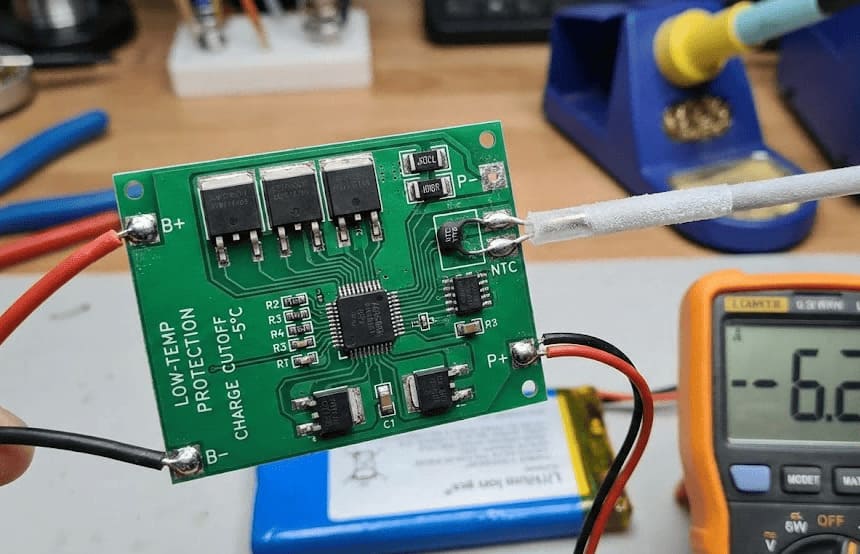
Low-Temperature Battery Protection Board: The Engineer's Guide to Cold-Weather BMS Design

Thank you! Wiltson Team will contact you shortly!
Date:2026-02-04

Low-Temperature Battery Protection Board: The Engineer's Guide to Cold-Weather BMS Design

Engineering Guide

Low-Temperature Battery Protection Board: The Engineer's Guide to Cold-Weather BMS Design

Low-Temperature Battery Protection Board
EJ

Ethan Jin

Senior Battery Engineer

TL;DR: The Executive Summary

  • Standard BMS units fail below 32°F (0°C) due to lithium plating risk and voltage sag.
  • Lithium plating is irreversible: A single cold charging event can permanently reduce capacity by 5-15%.
  • Temperature sensing accuracy matters: Specify ≤±1.0°C error from -22°F to 50°F (-30°C to +10°C).
  • Dynamic derating beats hard cutoffs: Smart BMS throttles current instead of cutting power.

The Cold Reality: Why Standard BMS Units Fail

North American winters don't care about your battery specs. From Minnesota to Manitoba, temperatures routinely drop below -4°F (-20°C). In Alaska, -40°F (-40°C) is just another January morning.

At these temperatures, lithium-ion batteries become expensive paperweights. Electrolyte turns viscous, ion transport slows, and internal resistance spikes. A battery showing 40% SOC can suddenly drop to zero under load.

The battery protection board is your last line of defense. Get it wrong, and even premium cells won't survive their first winter.

The Physics of Cold-Weather Failure

Lithium Plating: The Silent Killer

Below 32°F (0°C), lithium ions can't intercalate into the graphite anode fast enough. Instead, metallic lithium plates directly onto the surface, forming dendrites that puncture separators.

Result: Permanent 5-15% capacity loss per event.

Voltage Sag & False Shutdowns

At -4°F (-20°C), internal resistance spikes 3-5x. Under load, this causes severe voltage sag. A generic BMS interprets this as an empty battery.

Result: UVP triggers even with 80% charge remaining.

What Makes a BMS "Low-Temperature Capable"?

1Precision Temperature Sensing

  • Accuracy: ≤±1.0°C error from -22°F to 50°F (-30°C to +10°C)
  • Critical Range: ≤±0.5°C near 32°F (0°C)
  • Sensors: Minimum 1 per 6-12 cells at coldest spots
Critical Insight: Many manufacturers specify "±1°C at 25°C" but actual error at -20°C can exceed ±3°C.

2Intelligent Charge Protection Profile

Temperature Charge Limit Action
Below -20°C Disabled No charging allowed
-20°C to -10°C ≤0.05C Strict monitoring required
-10°C to 0°C ≤0.1C Derated current; preheat preferred
0°C to 5°C ≤0.3C Enable with hysteresis (3-5°C)
Above 5°C Normal Standard profile

3. Dynamic Derating

Don't just cut power. Throttle it.
32°F: 80% Power
-4°F: 30-50% Power

4. Heating Control

Activate at 41°F (5°C), Deactivate at 50°F (10°C). Priority: Heat pack before charging cells.

5. Comms Specs

AEC-Q100 Grade 1. X7R capacitors only (X5R fails in cold). CRC on all frames.

Common Engineering Mistakes

Mistake 1: Trusting 25°C Specs

Accepting "±1°C at 25°C" without seeing the full curve. At -20°C, error can be huge, enabling charging when unsafe.

Mistake 2: Ignoring Gradients

Using pack-average temp. Center cells might be warm, but perimeter cells are freezing and plating lithium.

Mistake 3: No Hysteresis

Simple cutoffs cause oscillation. You need a 5-9°F (3-5°C) gap between disable and re-enable.

Mistake 4: Cold Balancing

Disable balancing below 41°F. Voltage polarization makes imbalance look worse than it is.

Cost-Benefit Analysis

The Premium (+10-30%)

  • Precision Sensors +$15-30
  • AEC-Q100 MCU +$8-15
  • Heater Circuits +$10-20

The Payback

Field failure costs dwarf component costs:

  • • Module replacement: $500 - $5,000
  • • Service labor: $200 - $500

ROI: A $50 premium prevents a $3,000 failure.

Case Study: Wiltson PCM-L04S15

To illustrate proper design, let's examine the Wiltson PCM-L04S15-F87 4S 10A BMS, engineered for cold-climate LiFePO4.

Key Protection Logic

Multi-Zone Temperature

  • Charge Cutoff (Low)-4°F (-20°C)
  • Charge Recovery14°F (-10°C)
  • Note the 10°C hysteresis window.

Dual-Level Voltage

  • Overcharge L1 (Warning)3.75V ±0.1V
  • Overcharge L2 (Cutoff)3.90V ±0.1V
600µA
Sleep Current
18°F
Hysteresis Gap
3 Zones
Temp Sensors

Engineering Specification Checklist

Temperature Sensing

  • ≤±1.0°C from -30°C to +10°C
  • Sensors at coldest locations
  • Response time ≤20 seconds

Protection Logic

  • Hardware-based cutoff backup
  • Dynamic current derating
  • ≥3°C hysteresis on all limits

Conclusion

Designing for cold-weather operation means understanding lithium-ion physics and implementing protection that prevents irreversible damage while maintaining functionality.

Key takeaways:

  • Lithium plating is permanent: Every unprotected cold charge degrades cells forever.
  • Sensor accuracy determines safety: ±3°C error at freezing means you are guessing.
  • Quality pays: The BMS premium is a fraction of the cost of a single field failure.

Engineer Your Pack for the Extreme

Don't risk field failures. Wiltson Energy specializes in low-temperature BMS solutions validated for -40°C operation.

Consult a BMS Engineer

Custom design services available for industrial applications.

Sources:

Wiltson Energy PCM-L04S15-F87 DatasheetWiltson 4S 10A Bluetooth BMS Specifications

© 2026 Wiltson Energy. All rights reserved.

Looking for Our

Products and Services?

YES