

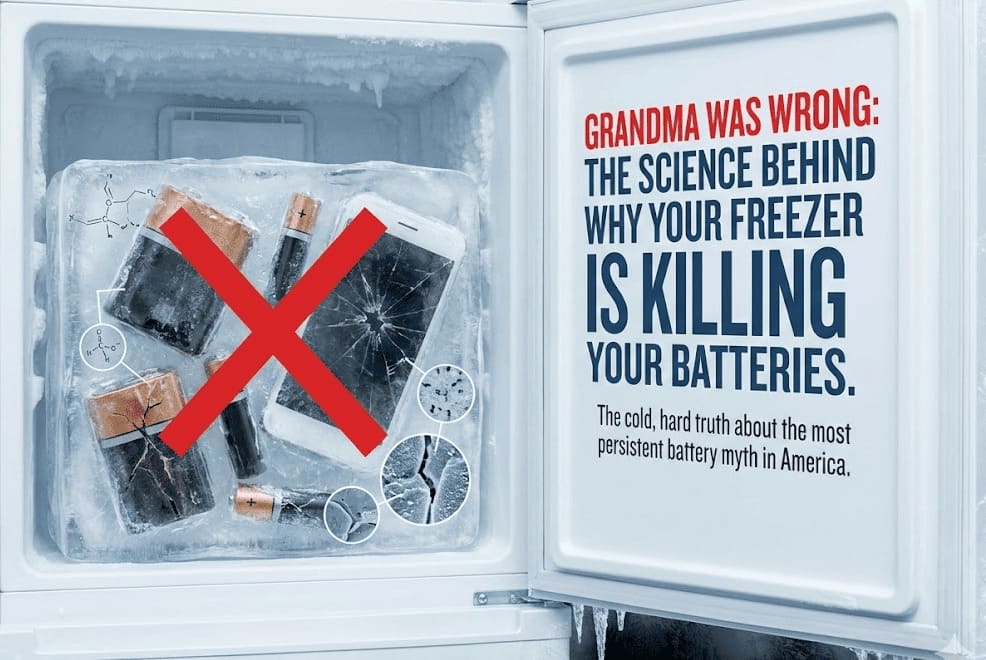
Grandma Was Wrong: The Science Behind Why Your Freezer is

Thank you! Wiltson Team will contact you shortly!
Date:2026-02-02

Grandma Was Wrong: The Science Behind Why Your Freezer is Killing Your Batteries

Consumer Science

Grandma Was Wrong: The Science Behind Why Your Freezer is Killing Your Batteries

The cold, hard truth about the most persistent battery myth in America.

battery-freezer-myth
EJ

Ethan Jin

Senior Battery Engineer

We've all seen it. Maybe you were digging through your grandmother's freezer looking for a popsicle, or hunting for leftovers. You push aside a tub of Cool Whip, and there it is: a Ziploc bag full of frosty AA batteries, nestled right next to the butter.

It's one of the most persistent "life hacks" in American history. And honestly? The logic feels sound. We freeze steak to keep it from spoiling. We freeze bread to keep it from getting moldy. So, if a battery is just a can of chemicals waiting to expire, shouldn't we freeze that too?

The Cold, Hard Truth

Grandma's advice is outdated. While her intentions were good, putting modern batteries in the freezer today isn't just useless—it's actively destroying the very thing you're trying to save.

1The Zombie Science (Why This Myth Won't Die)

To understand why this myth is so sticky, we have to admit something important: Grandma wasn't crazy. Thirty years ago, she was arguably a genius.

This myth is what scientists call "Zombie Science"—an idea that used to be true, but kept walking around long after the facts changed.

The "Slow-Motion" Effect

At the heart of this myth is the Arrhenius equation. Simply put: Heat is speed; Cold is a snooze button.

  • At 90°F (32°C): Chemicals inside are hyperactive. Reactions happen fast.
  • At 0°F (-18°C): Chemicals are sluggish. The reaction speed drops dramatically.

The NiCd Era

In the 80s and 90s, Nickel-Cadmium (NiCd) batteries were notorious "leaky buckets," losing 20-30% of their power just sitting in a drawer. Freezing them did help back then. But you aren't using NiCd batteries anymore.

The Modern Reality: Why It's a Bad Idea Now

The Moisture Monster

The biggest enemy isn't heat—it's water. Your freezer is a moisture factory. When you take a cold battery into a warm room, condensation forms immediately. This rusts the steel casing and ruins contacts.

The Lithium Risk

Lithium-ion batteries (phones, laptops) rely on liquid electrolytes. Freezing creates "sludge," leading to sharp metallic spikes called dendrites. These can puncture safety barriers and cause fires.

The Verdict: Know Your Chemistry
Battery Type Common Uses Freezer Verdict
Alkaline Remotes, Toys NO - Rust risk
NiMH (LSD) Eneloop, AA/AAA NO - Minimal gain
Lithium-Ion Phones, Laptops DANGER - Fire Risk

The Numbers Don't Lie

The "2% Rule"

Loss of capacity over one year sitting on a shelf:

2-3%
Room Temp
1%
Freezer

Result: You save about 5 minutes of usage per year.

The Economics of Risk

  • Cost of Battery $0.75
  • Cost of Device $60.00+
"Don't risk a $500 device to save a $0.50 battery."

When Was Grandma Right?

The only exception is the "Arizona Garage" Scenario. If ambient temps hit 120°F (49°C), your fridge acts as a protective bunker.

Prepper Protocol (10+ Years)

  1. Vacuum seal (remove air)
  2. Add Silica Gel desiccant
  3. Wait 24hrs after thawing to open

Rescue Mission

Already have batteries in the freezer? Don't panic. Follow the thaw protocol:

  • 1 Don't Open: Keep in the bag.
  • 2 Wait 24 Hours: Let them reach room temp slowly.
  • 3 Dry Wipe: Check for moisture before use.

Give Your Batteries a Room of Their Own

The "Freezer Hack" is a relic of a different time. The best place for your batteries is a cool, dry drawer—not the freezer. Science has spoken. Let Grandma keep her freezer for the pie.

Need Power Solutions for Extreme Environments?

Stop relying on kitchen hacks. Wiltson Energy provides professional-grade battery technology engineered to operate from -58°F to 140°F.

Talk to a Battery Expert

Custom solutions for industrial and consumer applications.

Sources:

© 2026 Wiltson Energy. All rights reserved.

Looking for Our

Products and Services?

YES