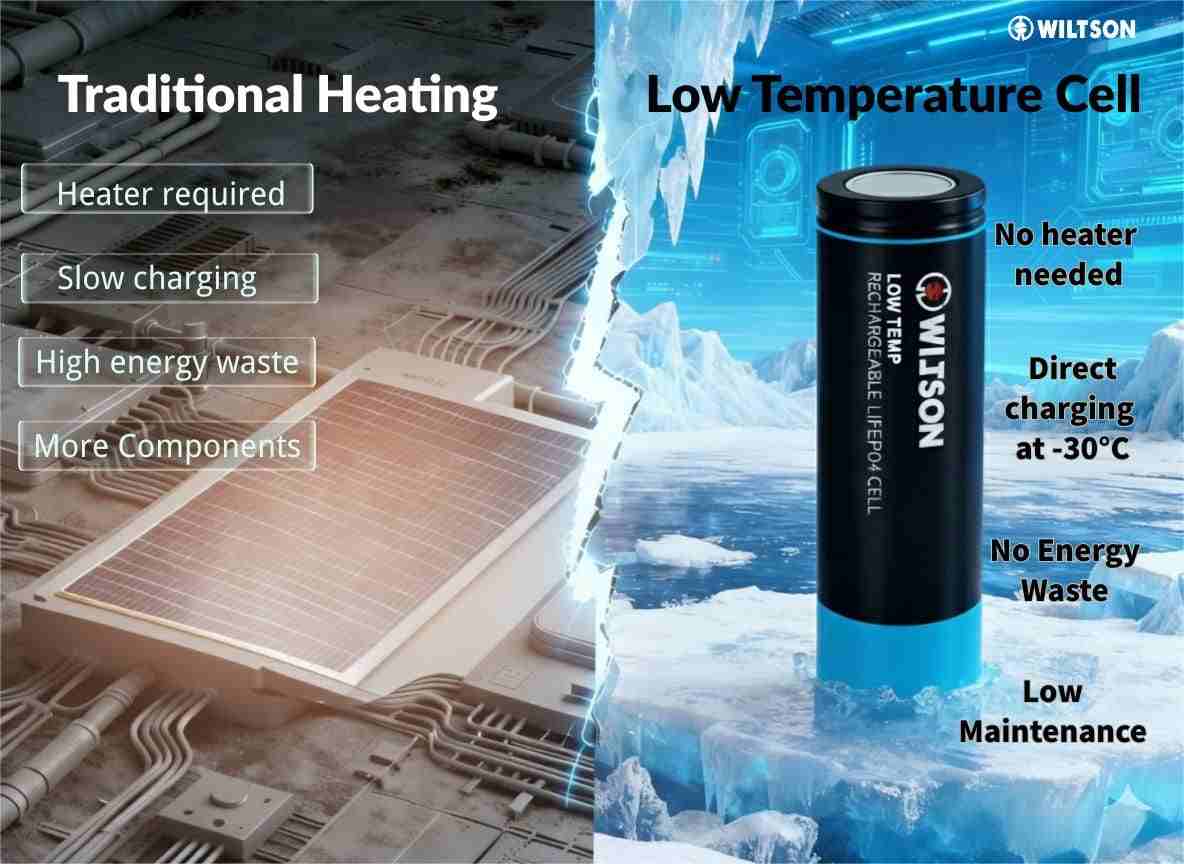
Self-heating lithium batteries integrate internal heating elements to maintain performance in cold weather, but this approach introduces energy penalties and system complexity that modern materials science has now eliminated.
Self-heating battery technology represented a breakthrough when introduced, yet today's intrinsically cold-tolerant batteries deliver superior performance without any thermal management infrastructure.
Key Findings
Self-heating systems consume 3.8-5.5% of capacity for heating, with real-world range losses reaching 20-40%[1][2]
Thermal management adds $1,000-$1,500 per system in hardware complexity[3]
Next-generation intrinsically cold-tolerant technology eliminates all heating energy losses
33% lower total cost of ownership over 5-year deployments
What is a Self-Heating Battery?
Definition and Core Technology
A self-heating battery is a lithium-ion battery system with integrated heating elements designed to raise internal temperature before or during cold-weather operation. Unlike external heating blankets or climate-controlled enclosures, self-heating lithium batteries incorporate the warming mechanism directly into the cell or pack architecture.
The engineering principle: maintain the battery above a critical temperature threshold (typically 0°C to 10°C) where lithium-ion chemistry functions efficiently. Below this range, lithium plating occurs during charging, electrolyte viscosity increases, and internal resistance rises dramatically.
How Self-Heating Battery Technology Works
1. Resistive Heating ElementsThe most common implementation uses thin nickel foil, stainless steel mesh, or carbon fiber heating films embedded between cells. The battery itself supplies power to the heating elements, managed by the Battery Management System (BMS).
2. Internal Heating via Pulse ChargingAdvanced designs use alternating current (AC) pulses or high-frequency charging cycles to generate internal heat through the battery's own resistance. This distributes heat more evenly but requires sophisticated control algorithms.
3. Self-Heating Chemical ReactionsEmerging research explored exothermic chemical additives or phase-change materials that release heat when triggered, though these remained largely experimental.
Key Components of Self-Heating Battery Systems
Heating elements: Conductive films or wires (0.1-0.5mm thick)
Temperature sensors: Multiple thermistors or RTDs throughout the pack
Thermal insulation: Enhanced layers to retain generated heat
Control circuitry: Dedicated heating control module within the BMS
Power management: Switching circuits to route power to heating elements
Why Self-Heating Was the Standard (The Legacy Solution)
Self-heating lithium battery technology represented a pragmatic engineering solution when it emerged. Understanding why it gained adoption—and why those advantages no longer justify the trade-offs—is essential for informed decision-making.
1. Extended Operating Temperature Range
Enabled operation from -20°C to -40°C where conventional batteries failed[4].
The Cost: Continuous energy consumption.
2. Protection Against Lithium Plating
Prevented charging at dangerously low temperatures, protecting capacity.
The Reality: Solved a symptom, not the root cause.
3. Established Supply Chain
Matured into a ~$500M market by 2025[5], creating established reliability data.
Question: Does maturity justify an inefficient approach?
The Hidden Costs of Self-Heating Systems
While self-heating lithium batteries solved the immediate cold-weather challenge, they introduced operational penalties that compound over deployment lifetimes.
1. The 20-40% Energy Penalty
The advertised cost: 3.8-5.5% capacity for heating[1]
The real-world impact: Battery heating reduces EV available range by 20-40% in very cold conditions[2].
Battery heating alone consumes 3-6 kWh per day when parked in cold weather[6]
Resistive heaters draw 4-8 kW continuously during operation[7]
For a 100-vehicle fleet: $80,000-$150,000 in annual heating energy costs
2. Hardware Complexity and Failure Points
Self-heating systems add multiple failure modes (hot spots, sensor drift, control failures). Commercial thermal management systems cost $1,000-$1,500 per unit[3].
3. The Fundamental Engineering Question
What if batteries could perform in extreme cold without any heating system at all?
Unlike self-heating lithium batteries that add complexity to force conventional chemistry to operate outside its natural range, Wiltson's approach engineers the electrochemical system itself to function efficiently at low temperatures.
The Core Breakthrough:
Zero heating energy loss. No thermal management infrastructure. Native operation from -40°C to 60°C.
How Wiltson's Technology Works
1. Advanced Electrolyte
Proprietary low-viscosity solvents that remain fluid at -40°C and specialized salts.
2. Optimized Electrodes
Cathode materials modified for low-temp ion diffusion and proprietary anode surface treatments.
3. Enhanced Separator
High-porosity separators designed for cold-climate ion transport with ceramic coatings.
Technology Comparison: Traditional Self-Heating vs. Wiltson No-Heating
Key Insight: Wiltson's technology doesn't just match performance—it eliminates the entire category of heating-related costs.
Frequently Asked Questions
How much energy does a self-heating lithium battery consume?
The baseline is 3.8-5.5% of capacity for heating[1], but real-world range loss reaches 20-40% in extreme cold[2]. Wiltson's technology eliminates this entirely.
What temperature range can self-heating batteries operate in?
Typically from -20°C to 50°C with active heating[4]. Wiltson's intrinsically cold-tolerant technology operates natively from -40°C to 60°C without any heating system.
How does this affect total cost of ownership?
For a 100-vehicle fleet over 5 years, self-heating battery energy costs add $80,000-$150,000. Wiltson's approach delivers 33% lower TCO.
Are self-heating batteries still relevant in 2026?
They remain viable for short-term deployments (1-2 years). However, for new long-term deployments, intrinsically cold-tolerant technology offers superior economics.
References
Self-heating process consumes 3.8-5.5% of battery capacity - Leading Manufacturer Datasheets
Battery heating reduces EV range by 20-40% in extreme cold - ChargedEVs
Commercial thermal management systems cost $1,000-$1,500 USD - Global Market Analysis