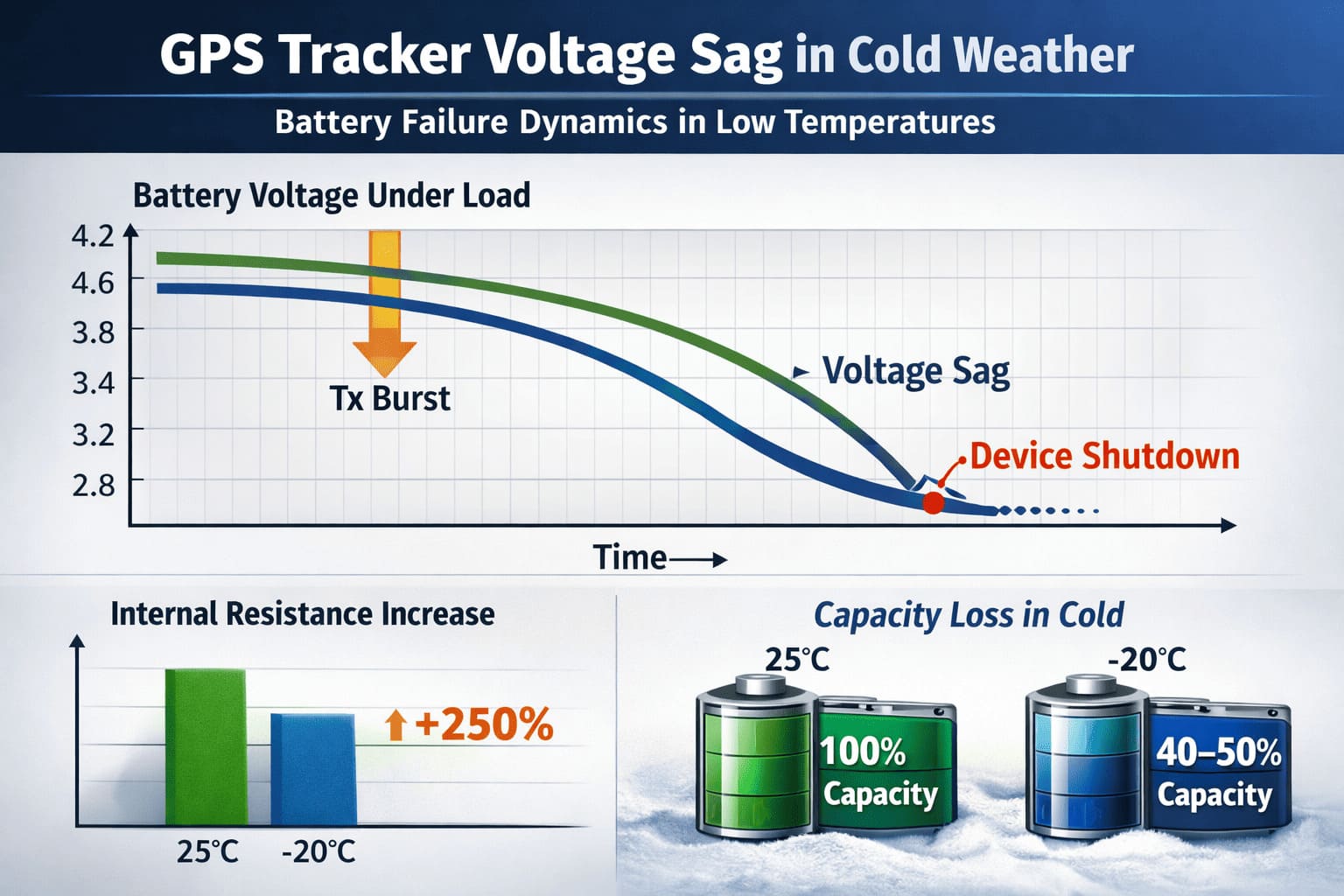
GPS tracking devices often encounter power failures in frigid conditions due to battery voltage sag. Voltage sag refers to a drop in the battery’s output voltage under load – a problem that worsens dramatically as temperatures plummet.
In cold weather, a tracker that runs fine at room temperature may suddenly reboot or shut off because its battery can no longer sustain the required voltage during a transmission burst. Below we dive into why this happens and how to fix it, in an engineer-to-engineer analysis with data-backed insights.
Why Cold Weather Causes Battery Voltage Sag
Cold = Higher Internal Resistance
Low temperatures cause internal chemical changes that increase a battery’s internal resistance and impede its performance. As electrolyte viscosity rises and ion mobility drops in the cold, the battery struggles to deliver current. Under the same load, a cold battery’s voltage will drop much more than at normal temperature – hence severe voltage sag. Laboratory data shows internal resistance can jump by +150–300% at −20 °C, drastically limiting power output. In practical terms, energy that’s stored in the cell becomes temporarily inaccessible. The battery’s voltage collapses under load, even if plenty of charge remains.
Capacity Loss in the Cold
Along with sagging voltage, the usable capacity of batteries plunges in low temperatures. At −20 °C, a typical 18650 Li-ion cell may deliver only 50–60% of its rated capacity. Automotive tests likewise find that winter cold can cut a battery’s effective capacity by 20–50%. This is not permanent loss – if the battery warms up, the remaining energy is still there – but while cold, the device can only tap a fraction of the energy before voltage drops off. Essentially, the battery “feels” emptier than it actually is when operating below freezing.
Voltage Sag Triggers Cutoffs
High internal resistance at low temp doesn’t just reduce capacity; it also trips safety cutoffs. When resistance increases, any current draw causes a larger voltage drop (Ohm’s law). The battery’s voltage under load can dip below the minimum operating threshold of the GPS tracker or its battery management system. As a result, the device might hit a low-voltage cutoff prematurely and shut down, even though the battery shows charge left. Studies confirm this chain reaction: cold-induced resistance causes voltage drop under load, reduced power output, and early low-voltage cutoff by the BMS. In short, a tracker in the cold may die suddenly because its battery sags to what appears to be an “empty” voltage level, triggering a fail-safe.
Failure Analysis: GPS Trackers Shutting Down in Winter
When a GPS tracker fails in cold weather, voltage sag is a prime suspect. Let’s break down a typical scenario: Most GPS trackers use lithium-ion batteries (often a single-cell LiPo pack ~3.7 V nominal). The tracker’s electronics (GPS module, cellular modem, etc.) require a stable voltage above some cutoff (often around 3.0 V for the Li-ion cell, or higher if there’s a boost converter). In warm conditions a healthy battery can easily meet this. But in winter, the margins vanish:
Burst Current Demands: GPS trackers don’t draw power evenly; the worst stress comes during communication bursts. For example, when the tracker’s GSM/GPRS or LTE modem sends data, it can pull up to ~2 A in short spikes. At room temperature, a good Li-ion cell might handle a 2 A burst with only a minor voltage dip (say from 3.7 V down to ~3.5 V). But at −10 °C, if the battery’s internal resistance has doubled or tripled, that same 2 A pulse could yank the voltage down below 3.0 V. The device browns out or resets mid-transmission. In essence, the cold battery can’t sustain the surge, and the tracker either reboots or goes offline when it tries to phone home.
Lead-Acid Vehicle Power Sags: Not all trackers run on internal batteries; many vehicle units are hardwired to the car’s 12 V lead-acid battery. Here too, cold weather wreaks havoc. A chilled lead-acid battery’s voltage can sag dramatically, especially during engine cranking (cold cranking amps draw). It’s common to see the car’s system voltage drop to ~9 V or less during a winter start. If the tracker isn’t on a sufficiently regulated circuit or lacks a backup supply, it may reset when the car is started on a freezing morning. Even aside from cranking, lead-acid batteries experience voltage sag when temperatures drop, causing devices to shut off prematurely or run inconsistently. In other words, a vehicle tracker can lose power or reboot simply because the car battery can’t maintain stable voltage in the cold. (This issue is well-known in winter – many users find that a lead-acid battery that appears charged will still let electronics fail due to unstable voltage.)
Symptoms in the Field: The telltale signs of cold-related voltage sag in trackers include: the tracker works fine indoors or in summer, but in sub-zero weather it stops transmitting, reboots frequently, or shows sudden battery drops. You might see the device indicating a decent battery level, then the moment it tries to send a position update, it dies. This pattern points to the battery voltage collapsing under load. In extreme cold, devices can shut down unexpectedly even when the battery indicator shows 30–40% charge – because under load that 30% plummets to the cut-off voltage instantly. Such failures are essentially a voltage sag induced brown-out, not a true depletion of the battery.
Solutions: How to Prevent Voltage Sag in Cold Weather
Engineers have several strategies to combat voltage sag in GPS trackers exposed to cold conditions. Both battery selection and system design choices can make a big difference:
Use Low-Temperature Optimized Batteries
Not all lithium batteries are equal in the cold. Chemistry and cell design play a huge role in performance below 0 °C. For instance, Lithium Iron Phosphate (LiFePO₄) cells are prized for cycle life and safety, but standard LiFePO₄ chemistry performs poorly in cold weather – it has high internal resistance at low temp. Nickel-based lithium chemistries like NMC/NCA tend to handle the cold better. Within each chemistry, some manufacturers offer “low-temperature” cells formulated with special electrolytes or additives for sub-zero operation. These can dramatically improve performance. For example, a standard NCM Li-ion battery might retain only ~40–55% of its capacity at −20 °C, and a regular LiFePO₄ only ~30–40%, whereas a properly engineered low-temp cell can sustain 75–85% capacity at −20 °C. Even at −30 °C, specialized cells have ~60–70% capacity where normal cells are nearly unusable. The takeaway: choose batteries rated for cold. Consult the datasheets and look for cells tested at –20 °C or below.
It’s often wise to overspec the battery for cold environments. A larger capacity (higher mAh) battery or multiple cells in parallel will have lower internal resistance and more voltage headroom under load. This means less sag for a given current draw. In a design phase, if you expect –20 °C operation, consider upsizing the battery or using a cell that comfortably supplies, say, 2–3 times the normal current draw of the tracker. The extra overhead can ensure that even when cold slows the battery down, it can still meet the tracker’s peak power needs without dropping out.
Add a Power Buffer (Capacitors)
A clever hardware fix to mitigate voltage sag is to include a high-value capacitor or supercapacitor across the power input of the GPS tracker’s modem or main board. During a sudden burst (e.g. the modem calling in), the capacitor can supply instantaneous current, buffering the load on the battery. This helps keep the voltage steadier. Essentially, the cap charges slowly from the battery (which it can handle even in cold), then during a spike it discharges, supporting the battery. Many IoT engineers use this trick to prevent brown-outs during GSM transmission. It’s especially useful in cold conditions where the battery’s effective internal resistance is high – the supercap provides a low-resistance reservoir to handle transient peaks. Note: The capacitor needs to be sized and chosen appropriately (low ESR, rated for low temperatures as well).
Thermal Management
Keeping the battery warm is an obvious but sometimes overlooked solution. If the device will be operating in extreme cold, insulating the battery compartment or providing some form of heating can maintain performance. Some advanced tracker battery packs include built-in heaters or thermal regulation. For example, a low-temp LiFePO₄ pack might incorporate a thin film heater that kicks in below –10 °C. The heater uses a bit of power, but it warms the cell enough to dramatically reduce internal resistance and prevent lithium plating during charging. Even without active heating, simple measures help: placing the tracker in a location that’s shielded from wind chill, or near other electronics that generate heat, can keep the battery a few degrees warmer. In vehicle installations, mounting the unit inside the cabin rather than an exposed spot under the hood can make a big difference on frigid days.
Optimize Firmware Settings
From a system perspective, one can adapt the tracker’s behavior in low temperatures to ease the load. This might involve reducing the frequency of GPS position uploads in extreme cold or lowering the cellular transmission power when possible. By sending data less often (or using more efficient protocols), you reduce how frequently those high-current bursts occur, giving the battery a gentler duty cycle. Some trackers and IoT modules can also delay non-critical functions when the battery voltage is observed to be low, effectively implementing a “cold mode” of operation. These tweaks can prevent a cascade of voltage sag events. (In fact, experiments have shown that optimizing reporting intervals and power usage can extend battery life by a significant margin – one study found up to 30% longer runtime just by throttling update frequency and power use in harsh conditions.)
Battery Maintenance and State-of-Charge
Finally, ensure the battery is healthy and fully charged before entering cold conditions. An aging battery or one that’s partially discharged has less buffer against voltage drop. In fleet trackers, regularly check the health of both internal backup batteries and the vehicle battery (for hardwired units) as winter approaches. A fresh, well-charged battery will always handle the cold better. Also, if the device will be stationary in cold weather for long periods, consider a trickle charging solution (for vehicle trackers) or swapping batteries periodically for charged ones (for portable units) to avoid letting a cold-soaked battery get too low, where it’s most vulnerable to sag.