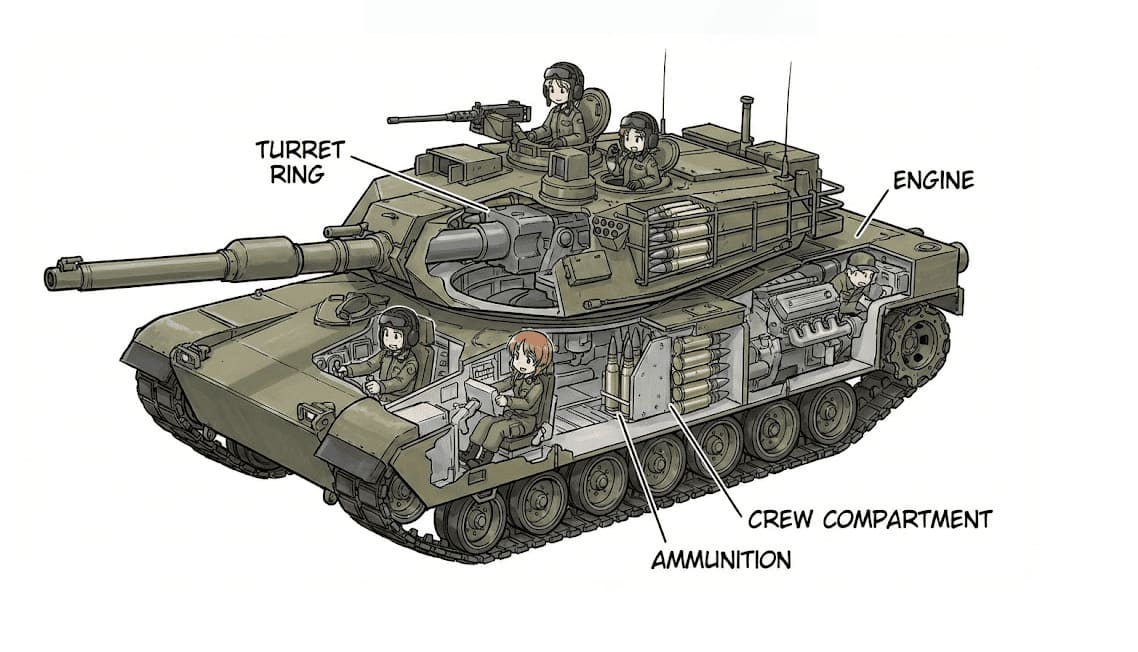
A Main Battle Tank (MBT) in a defensive position must power active protection systems, thermal imaging, and encrypted comms with the engine off. Traditional lead-acid batteries last barely 2-3 hours before voltage collapse forces an engine restart—compromising stealth.
This is not a battery problem. This is a force readiness problem.
1. The Silent Watch Advantage – LiFePO4 as a Force Multiplier
The term "force multiplier" is often overused in defense procurement. In the context of tank power systems, however, lithium iron phosphate (LiFePO4) chemistry delivers a quantifiable tactical edge that meets the definition precisely.
The Peukert Penalty: Why Lead-Acid Fails Under Load
Lead-acid batteries suffer from a well-documented electrochemical limitation: at high discharge rates, their effective capacity plummets. A 100Ah AGM battery discharged at 1C (100A) may deliver only 30-40Ah of usable energy before terminal voltage drops below the 21V threshold required by MIL-STD-1275 vehicle electronics.
LiFePO4 operates under entirely different physics. Our 26650-based 6T battery pack, rated at 100Ah nominal, delivers 95Ah+ of usable capacity at continuous 50A draw (0.5C). The voltage curve remains flat at 25.6V ±1V throughout 80% of the discharge cycle, ensuring that fire control computers, laser rangefinders, and APS radar never experience brownout conditions.
Operational Impact: 10+ Hours of Silent Watch
Where a lead-acid 6T battery provides 2-3 hours of Silent Watch before requiring engine restart, our LiFePO4 solution extends this to 10+ hours under identical 50A load conditions. In practical terms:
A platoon can hold a defensive position through an entire night without thermal signature exposure
Reconnaissance elements can conduct extended surveillance without compromising stealth
Logistical fuel consumption drops by 60-70% during static operations
2. Cold Cranking & Voltage Sag – The Hidden Failure Mode
Cold Cranking Amps (CCA) specifications dominate procurement discussions, but CCA alone is a dangerously incomplete metric. The critical question is not whether a battery can deliver 1000+ amps at -18°C, but whether it can do so while maintaining sufficient voltage to keep onboard electronics operational during the cranking event.
The Voltage Sag Problem in Lead-Acid Systems
When a lead-acid 6T battery attempts to cold-crank a 1500HP diesel engine at -30°C, internal resistance spikes. Even if the battery delivers the required 1200A, terminal voltage can sag to 14-16V during the 5-10 second cranking cycle.
Consequences for a 24V nominal system:
Fire Control System (FCS) reboot: Modern digital fire control requires >18V. A voltage sag triggers a full restart, adding 60-90 seconds before the gun is combat-ready.
BMS data loss: Battlefield management systems may lose GPS lock or encrypted network connections.
APS false triggers: Active protection radar modules can misinterpret voltage transients as threat signals.
LiFePO4 Solution: Voltage Stability Under Extreme Load
Our 26650 LiFePO4 cell matrix maintains >22V terminal voltage even while delivering 1200A CCA at -30°C. This is achieved through:
Ultra-low internal resistance: Each 26650 cell exhibits<25mΩ AC impedance at 1kHz. In an 8S25P configuration, parallel resistance drops to ~1mΩ per string.
Flat discharge plateau: Nominal pack voltage remains stable across 20-80% state of charge, even during pulse discharge events exceeding 10C.
Chemically Engineered Low-Temperature Performance: Our proprietary low-viscosity electrolyte formulation enables instant high-current delivery at -30°C with zero warm-up delay. No pre-heat cycle, no additional power consumption, and no thermal signature.
Tracked vehicles operate in a mechanically hostile environment. Shock loads can reach 30G, with continuous high-frequency vibration. Traditional AGM batteries use thin lead plates suspended in fiberglass mats. Under sustained vibration, plates warp, active material sheds, and grids corrode, leading to premature failure.
26650 Cylindrical Cells + Potting: A Monolithic Solution
Our approach leverages the inherent mechanical advantages of cylindrical cell geometry:
Steel Can Integrity
Each 26650 cell is housed in a nickel-plated steel canister acting as a pressure vessel, proven in high-shock power tool applications.
Jelly-Roll Construction
Tightly wound electrode stacks distribute mechanical stress evenly, resisting the bending moments that delaminate pouch cells.
Thermal Potting
The 200-cell array is encapsulated in epoxy potting compound, transforming it into a monolithic block that resists shock and seals against contaminants (IP67).
Ultrasonic Wire Bonding
We use 1.5mm aluminum wire bonding with redundancy. If one wire fatigues, others maintain continuity.
Validation: MIL-STD-810H Vibration Testing
After undergoing Category 4 (Tracked Vehicle) vibration profiles and 40G shock testing, our units showed zero cell failures and less than 2% capacity degradation.
4. Total Cost of Ownership (TCO) Analysis
While the upfront cost of LiFePO4 is higher, a lifecycle analysis reveals dramatic savings in operational contexts.
Parameter
6T AGM Lead-Acid
Wiltson LT LiFePO4
Advantage
Unit Weight
40 kg
15 kg
62.5% reduction
Cycle Life (80% DOD)
300 cycles
3500+ cycles
11.7× longer
Silent Watch Duration
2-3 hours
10+ hours
4× extension
Replacement (10 yrs)
8-10 units
1 unit
90% fewer replacements
Cold Cranking (-30°C)
Voltage sag to 16V
Stable >22V
No FCS reboot
Fuel Savings
Baseline
High
~$8,000/vehicle/year
Total 10-Year Cost
~$18,000
~$12,000
33% TCO reduction
Hidden Costs of Lead-Acid Failure
Mission aborts: Dead batteries during pre-checks force vehicle substitution.
Operational restrictions: Limits tactical flexibility in cold theaters.
Logistics burden: Handling 12kg of lead waste per unit creates regulatory burden.