



Why EVs Lose Up to 50% Range in Winter – Wiltson No-Heater Battery 2026
Why EVs Lose Up to 50% Range in Winter —And How Wiltson Energy's No-Heater Batteries Solve Extreme Cold in 2026

Senior Battery Engineer, Wiltson Energy
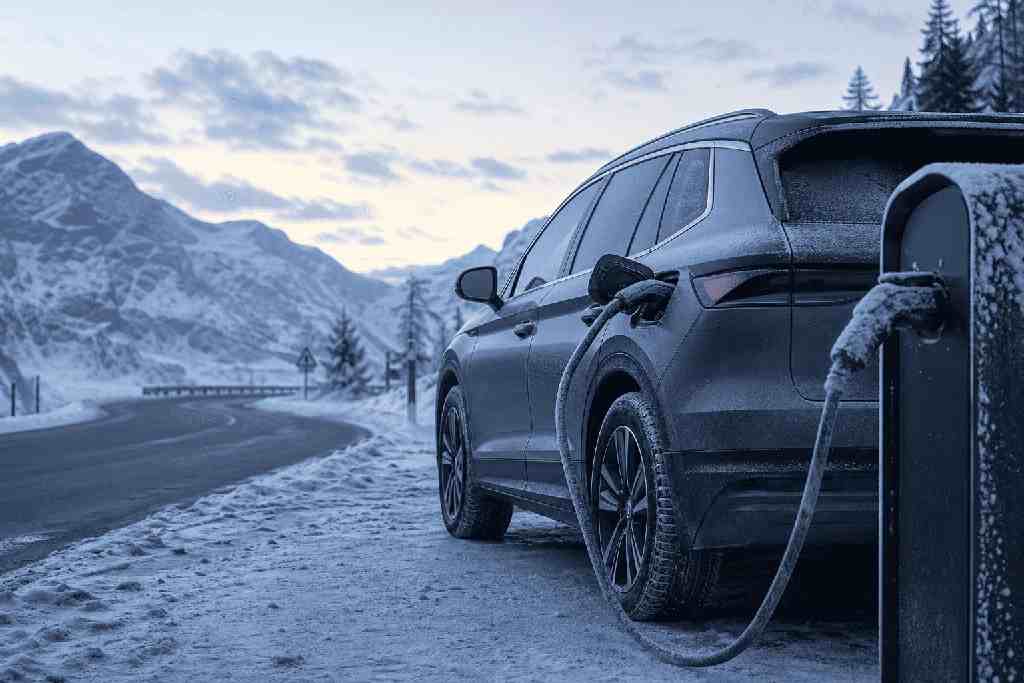
You wake up to 20°F (-7°C). Your EV shows far less range than yesterday, and charging crawls at a fraction of normal speed. Nothing is broken — this is exactly how today's lithium batteries behave in the cold.
The Data
According to the U.S. Department of Energy and Argonne National Laboratory (2024 Program Record), the average BEV loses 41% of its range at 20°F (-7°C) with cabin heating on. At 0°F (-18°C) the penalty climbs to roughly 50%. Turn off cabin heat entirely, and the battery itself still loses about 12% — the rest comes from HVAC load, BMS protection, and electrochemical slowdown.
Most solutions still depend on preconditioning, heat pumps, or external heaters. For industrial, off-grid, and extreme-cold applications, those add cost, weight, and complexity that the power budget cannot absorb. This is where Wiltson Energy's low-temperature LiFePO4 technology changes the engineering equation — direct charging at -30°C and reliable discharge to -40°C, no heating module required.
Why Cold Attacks Lithium Batteries
Cold creates three overlapping electrochemical failures simultaneously. The BMS throttles charging to prevent them, preconditioning burns energy to warm the pack, and drivers feel the compounded winter penalty.
Electrolyte Viscosity
Organic carbonate solvents thicken at low temperatures, slashing ionic conductivity and raising internal resistance. The result is immediate voltage sag under acceleration load.
Lithium Plating
Cold graphite anodes cannot absorb lithium ions fast enough during charging. Metallic lithium deposits on the surface instead — permanently reducing capacity and raising dendrite risk.
SEI Layer Growth
The protective solid-electrolyte interphase thickens unevenly under repeated cold stress, compounding impedance over successive winters — degradation that doesn't recover.
Real-World Winter Data
DOE testing isolates the variables: HVAC load is a major culprit, but thermal management strategy determines how well a pack fights back. NAF (Norwegian Automobile Federation) winter road tests show enormous spread between models — some lose only 4%, others up to 35% — proving that integration matters as much as chemistry.
Chemistry comparison in cold weather:
| Parameter | Nickel-rich NMC | Standard LFP | Wiltson Low-Temp LFP |
|---|---|---|---|
| Range retention at -20°C | 65–75% | 40–60% | ~85% |
| Charging below 0°C | Pre-heat required | Pre-heat required | -30°C direct, no heater |
| Cycle life in cold | 500–800 cycles | 800–1,200 cycles | 1,500+ cycles |
| Best cold-climate use | Long-range passenger EVs | Urban / mild-winter EVs | Extreme cold / off-grid |
Representative engineering ranges across cell classes, not a single OEM dataset.
The Research Pushing Boundaries
The most credible 2025–2026 work targets the real bottlenecks — interface resistance, electrolyte transport, and cold-charge plating risk — rather than replacing chemistry wholesale. These results are not yet in production vehicles.
- University of Michigan / Joule 2025 — demonstrated 6C charging at -10°C without measurable lithium plating, with >97% capacity retention after 100 cycles. Lab-stage demonstration; re-engineers the anode interphase rather than relying on external heating.
- Argonne National Laboratory — fluorinated electrolyte formulation showed stable cycling over 400 charge-discharge cycles at -20°C, comparable to conventional cells at room temperature.
- Nature 2026 — DFP-based hydrofluorocarbon electrolyte reported 0.29 mS/cm ionic conductivity at -70°C with oxidative stability above 4.9V. Lab-stage; commercialization path is years, not months.
Born for the Cold: What Industrial Deployment Actually Requires
Consumer EVs have a privilege most industrial battery applications do not: spare energy to protect themselves. A passenger car can precondition on grid power, run a heat pump, and warm the pack before charging. An off-grid weather station at 70°N has none of that overhead to spend. A remote sensor running on a small solar panel cannot sacrifice winter solar yield just to keep the battery warm enough to accept charge.
This is the engineering split. Standard passenger-EV LFP — optimized for cost, safety, and calendar life — requires preheating to charge safely below 0°C. Wiltson's low-temperature LiFePO4 cells are built around a different assumption: the battery must work cold natively, without a heating module.
Real-world proof: Mount Everest 2025 deployment
At -40°C and 8,848 meters, Wiltson cells powered the world's highest automatic weather station and ice-core drilling equipment for 12 continuous days with zero maintenance and >80% discharge efficiency. No heating pads, no additional BMS sensors, no grid connection.
The same cells are deployed in North American oil & gas pipeline monitoring, Canadian and Alaskan drilling sensors, and cold-climate solar trackers — cutting installation and operational cost by eliminating heater components entirely.
Wiltson Low-Temp Pro Series vs standard LiFePO4:
| Parameter | Standard LiFePO4 | Wiltson Low-Temp Pro Series |
|---|---|---|
| Charging Temperature | ≥0°C (pre-heat required) | -30°C direct |
| Discharge Temperature | -20°C typical | -40°C / -50°C, >90% efficiency |
| C-Rate at -40°C | Severely limited | Up to 7C |
| Heater Required | Usually yes | None |
| Cycle Life (cold) | Drops sharply below 0°C | 1,500+ cycles |
FAQ
1. Why do EVs lose so much range in winter?▼
Cold thickens electrolyte, triggers BMS charge limits to prevent lithium plating, and forces HVAC to consume battery energy. DOE/Argonne's 2024 Program Record puts the average BEV range penalty at 41% at 20°F (-7°C) with cabin heat running. Without cabin heat, the battery itself loses only about 12%.
2. Is winter range loss from the battery or the heater?▼
Both — but heating matters more than most drivers expect. DOE data shows range at 20°F is only about 12% lower without cabin heat. The remaining real-world winter loss comes from HVAC load, thermal management overhead, and reduced electrochemical performance stacking together. In practice, the three are inseparable.
3. Is it safe to fast-charge an EV in sub-zero temperatures?▼
Yes, if the vehicle manages the process correctly. The risk is pushing cold graphite cells above their safe charge rate, triggering lithium plating. That is why the BMS reduces charging current when the pack is cold-soaked — and why preconditioning before a DC fast charge makes the subsequent session faster and safer.
4. Is LFP worse than NMC in cold weather?▼
For mainstream passenger EVs, standard LFP is more sensitive to cold primarily on charge acceptance, not only range. Cold LFP packs often cannot take meaningful charge until preheated. NMC generally holds an advantage for long-range winter EV use. LFP remains attractive for cost, safety, and durability in urban applications when paired with solid thermal management.
5. Will solid-state or sodium-ion batteries fix cold-weather performance in 2026?▼
Not for mainstream consumer EVs in 2026. Solid-state remains in limited pilot production and has its own cold-temperature interface challenges. Sodium-ion shows strong capacity retention above 90% at -20°C but energy density is still below 160 Wh/kg — constraining long-range applications. The near-term needle-movers are better electrolyte formulations and smarter thermal management.
6. Do you need a battery heater if you use low-temp LFP chemistry?▼
Not if the chemistry is genuinely engineered for sub-zero charging. That is the distinction between commodity EV LFP — which requires preheating to charge safely below 0°C — and purpose-built low-temperature LFP specified to charge at -30°C under defined current limits without an external heater. The difference is validated cell-level charge behavior at temperature, not marketing language.
7. What specifications should I ask a battery supplier for cold-weather industrial deployment?▼
Don't ask "what is your minimum operating temperature?" Ask for: validated charge current limits at -20°C and -30°C, capacity retention curves at -30°C and -40°C, and cycle-life data under repeated sub-zero charging. A temperature range on a brochure without test conditions tells you very little about real-world behavior.
Conclusion
Winter range loss is real, but the underlying problems are well-understood and increasingly targetable. While research labs continue pushing electrolyte and interface boundaries, Wiltson Energy has already commercialized the practical answer for extreme cold: low-temperature LiFePO4 cells that charge at -30°C and discharge reliably to -40°C without any heater.
For passenger EVs, better thermal management and electrolyte engineering still matter. For industrial, remote, and mission-critical applications — from Arctic pipelines to high-altitude sensor arrays — no-heater cell chemistry eliminates the compromise entirely. The engineering question is not "how do we heat the battery?" It is "how do we build a battery that doesn't need to be heated?"
Ready for real cold-weather performance in 2026?
Get validated charge/discharge data at -30°C and -40°C for your specific application.
Request Cell Data from Wiltson EnergyCold-temperature charge curves, cycle-life data, and application engineering support.