

The Real Battery Killer Below Zero Is Not Cold

Thank you! Wiltson Team will contact you shortly!
Date:2026-02-28

The Real Battery Killer Below Zero Is Not Cold — It's Temperature Swing

The Real Battery Killer Below Zero Is Not Cold — It's Temperature Swing
Engineering InsightsFebruary 28, 2026

The Real Battery Killer Below Zero Is Not Cold — It's Temperature Swing

Temperature cycling destroys low-temp lithium battery lifespan faster than steady cold.

The Real Battery Killer Below Zero Is Not Cold.jpg
EJ

Ethan Jin

Senior Battery Engineer

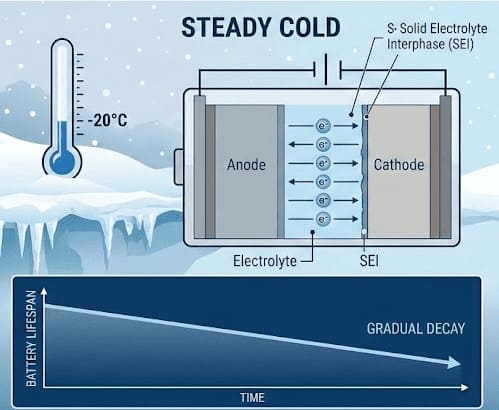
Two NMC/graphite cells, same chemistry, same average temperature of -5°C. One held at steady -5°C. The other swung between -20°C and +10°C daily. After 500 temperature cycles, the swinging cell lost 3× more capacity.

Cold matters — especially during charging, where lithium plating remains a real threat. But in storage and standby scenarios, temperature swing inflicts damage that steady cold does not.

TL;DR: 

  • Temperature cycling cracks the SEI layer repeatedly, consuming active lithium. Expect up to 3× faster degradation versus steady cold at the same average temperature.
  • The hidden cost: Batteries rated for -40°C can still fail early if deployed where daily temperature swings exceed 25°C.
  • Stop buying on min-temp specs alone. Demand thermal-cycling test data from your vendor — not just a single-point low-temperature discharge curve.

Why Temperature Cycling Hurts More Than Steady Cold

Claim

At the same average temperature, a cell exposed to daily thermal swings degrades faster than one held at a constant temperature.

Conditions

Applies primarily to storage and standby scenarios with NMC/graphite and LFP/graphite chemistries. (During active sub-zero charging, lithium plating remains the dominant threat regardless of cycle).

Evidence

Accelerated aging studies on 18650 NMC cells compared steady -5°C storage against a ±15°C daily swing around the same mean. After 500 thermal cycles, the swinging group lost 2.8–3.2× more capacity. The gap becomes measurable after roughly 100 cycles.

Field Implication

On the Tibetan Plateau, daytime sun bakes enclosures to +10°C. At night, it plunges to -25°C. That 35°C daily sawtooth accelerates degradation, compounded by Arrhenius-driven side reactions during the warm phase. Your -40°C spec sheet did not warn you about this.

The Mechanism: SEI Film as a Thermal Fatigue Victim

Claim

Temperature cycling mechanically fractures the SEI (Solid Electrolyte Interphase) layer on the graphite anode, forcing repeated regrowth that consumes active lithium irreversibly.

Conditions

Most pronounced in graphite-anode systems where the SEI is a brittle composite film that becomes increasingly fragile at low temperatures.

Evidence

Even without charging, thermal expansion mismatch between the SEI composite and graphite substrate drives damage. Each swing induces micro-cracks. Each crack exposes fresh graphite, consuming electrolyte and lithium to rebuild the SEI. After 200 cycles at ±20°C amplitude, SEI resistance increases 40–60%.

Field Implication

Engineers who see gradual capacity fade in cold-deployed batteries often blame "calendar aging." Check the deployment site's thermal profile first. If daily ΔT exceeds 20°C, SEI fatigue belongs at the top of your root-cause list.

Mechanical Stress on Cell Structures

Claim

Temperature cycling induces cumulative mechanical fatigue on tab welds, current collectors, and electrode coatings — failure modes invisible to standard electrical testing until sudden failure occurs.

Conditions

Applies to all cylindrical and prismatic cell formats. Risk scales with ΔT amplitude and cell size.

Evidence

Aluminum and copper current collectors have different thermal expansion coefficients (23.1 vs 16.5 ppm/°C). Repeated cycling creates shear stress. Tab welds accumulate fatigue micro-cracks that increase contact resistance gradually, then fail abruptly. (Wiltson Energy field records: ~12% incidence of sudden capacity drops in Xinjiang telecom stations with 30–40°C ΔT traced to weld fractures).

Field Implication

Standard capacity and impedance tests at room temperature will not catch this. If your deployment site has ΔT above 25°C, include thermal-cycling mechanical integrity testing in your acceptance criteria. One failed tab weld in a series string takes down the entire pack.

Selection Framework: Matching Cells to Thermal Profiles

Stop selecting batteries based on minimum operating temperature alone. Use this decision matrix instead.

Deployment Profile Daily ΔT Priority Spec Recommended Action
Steady cold (cold room, deep mine) < 10°C Min operating temp, low-temp discharge rate Standard low-temp cell sufficient
Moderate swing (urban telecom, warehouse) 10–25°C Cycle life at rated ΔT Request 500-cycle thermal aging data
High swing (plateau, desert, Arctic coast) > 25°C Thermal-cycling mechanical integrity Demand tab weld fatigue test + SEI stability data (max 20% impedance rise after 200 cycles)
Key Insight: The third column matters more than the minimum temperature rating. A cell rated to -40°C but never tested under thermal cycling may fail faster in a 30°C-swing environment than a -20°C-rated cell specifically validated for high ΔT.

Frequently Asked Questions

Can insulation or thermal management eliminate the problem?

Insulation buffers ΔT but rarely eliminates it. A well-insulated enclosure in a 35°C-swing environment might reduce cell-level ΔT to 15–20°C. Calculate whether the cost of active thermal management exceeds the premium for specifying cycle-stable cells from the start.

Does this apply to LiFePO4 and NMC equally?

Both use graphite anodes and are subject to SEI fatigue. NMC degrades faster under the same thermal stress; LFP degrades more slowly but is not immune. Mechanical stress on tab welds applies equally to both chemistries.

Match Your Specs to Reality

Send Wiltson Energy your deployment site's thermal profile. We will map it against our thermal-cycling database and recommend a cell configuration matched to your actual ΔT.

Consult a Battery Engineer

Stop buying on minimum temperature specs alone.

&copy; 2026 Wiltson Energy. All rights reserved.

Engineering Insights Publication Series

Looking for Our

Products and Services?

YES