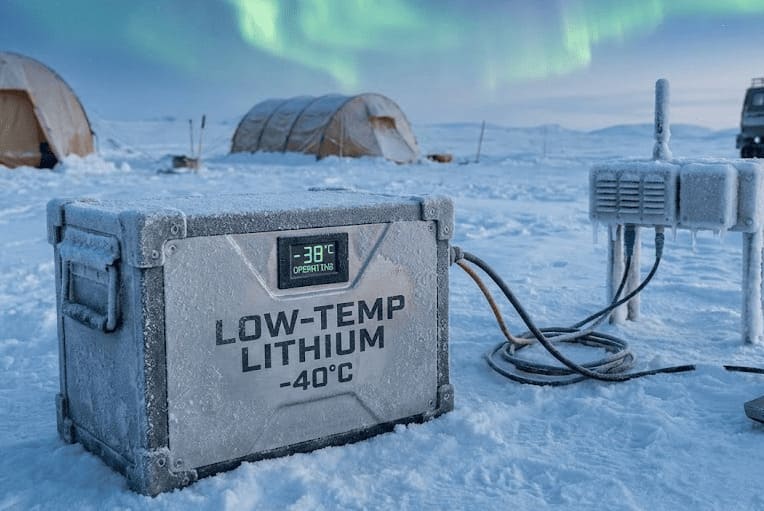
A low temp lithium battery decision starts with system behavior: cold-start, charge limits, and recovery targets.
Charging limits in the cold are the bottleneck; define them before you select hardware.
Use documented test conditions and field data; if those are missing, treat it as risk.
1) Define system behavior before you pick cells
A low temp lithium battery is not a drop-in swap. Start with behavior: how quickly the system must recover from a cold soak and whether charging must happen below freezing. That definition should drive your low temp lithium battery specification.
Key Insight:
If requirements stop at chemistry, integration failures show up in the field.
Cold-weather failures are usually system failures: BMS logic blocks charging, sensors drift, and seals or connectors become brittle. These issues can cause a low temp lithium battery to underperform even when cells are capable.
Common Mistake:
Treating a low temp lithium battery as a hardware swap without updating BMS rules and commissioning steps.
Wiltson Energy’s approach uses intrinsic chemistry rather than heaters. The knowledge base describes low-viscosity ester solvents with freezing points down to -84°C and nano-scale electrode materials intended to reduce lithium plating risk during cold charging.
The performance table lists a -30°C charging lower limit and -50°C discharge lower limit for Wiltson intrinsic low-temp cells. For a low temp lithium battery, that difference between charging and discharging is a system design constraint, not just a spec sheet line.
Non-negotiable: The cold-charge limit must be enforced in the BMS configuration and verified during commissioning.
4) Evidence you should require before approval
At minimum, request test protocols, charge/discharge profiles, and BMS limits used during testing. The knowledge base cites >90% capacity retention at -40°C at 1C discharge and startup time under 1 second. Those figures are meaningful only when test conditions are disclosed.
5) Direct cold charging vs heating
Heating pads can consume 20-40% of available solar energy and add 30-60 minutes of warm-up time. Wiltson intrinsic low-temperature cells are specified for direct charging down to -30°C.
Trade-off:
Direct cold charging reduces complexity but demands better evidence; heating can be simpler to validate if you have energy headroom.
6) Application-based validation example
Cold-storage AGVs: In-situ charging at -25°C raises productive time from 63% to 90%+ and cuts three-year TCO by 30%, with about $660,000 savings for a 10-AGV fleet in the cited example.
Lab validation using your site temperature profile
Pilot deployment with enhanced logging
Full rollout with acceptance criteria and rollback plan
8) FAQ (engineer-to-engineer)
Q1: Can a low temp lithium battery charge below freezing?
A: Wiltson’s intrinsic low-temperature cells are specified for charging down to -30°C; verify test conditions before use.
Q2: Is heating always necessary?
A: Not if direct cold charging is reliable; heating pads can consume 20-40% of available solar energy and add 30-60 minutes of warm-up time.
Q3: What low-temperature performance should I require?
A: Use capacity retention at your lowest operating temperature as the baseline; Wiltson reports >90% capacity retention at -40°C at 1C.
Q4: What about safety and certifications?
A: The knowledge base lists UN38.3, IEC 62133, UL 1642/2054, CE, and RoHS certifications, plus nail penetration and gunshot tests with no smoke or fire.
Q5: How long will a low temp lithium battery last?
A: Wiltson cites 2000-4000 cycles and 10-12 years of life in typical applications.
Q6: What is the business case?
A: The AGV example cites 90%+ uptime and a 30% three-year TCO reduction with about $660,000 savings for a 10-AGV fleet.
Next Steps
If you are evaluating a low temp lithium battery for a cold-climate project, Wiltson Energy can help translate your site requirements into a test plan and procurement checklist.