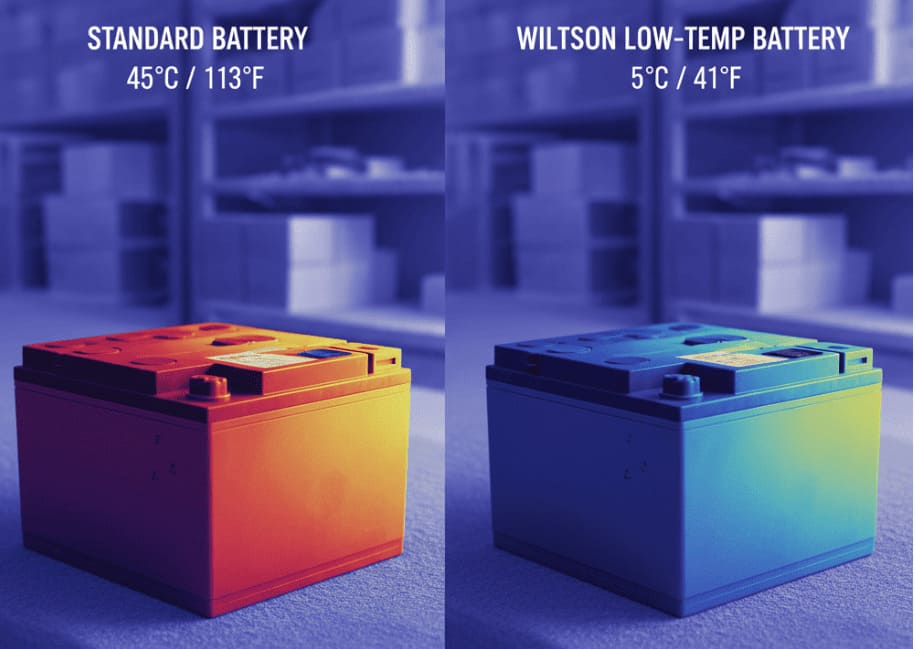
In military procurement, we often focus on the traditional SWaP-C metrics: Size, Weight, Power, and Cost. But there's another "S" that's equally critical in modern combat environments—Signature. Specifically, the thermal and electromagnetic signatures that can compromise a soldier's position and mission success.
For decades, the conventional approach to cold-weather battery performance has been straightforward: when temperatures drop, add heating elements to keep the cells warm. While this solution addresses the immediate problem of battery performance degradation, it introduces three critical vulnerabilities that are increasingly unacceptable in modern tactical operations:
Thermal signatures that make soldiers visible to enemy thermal imaging systems
Electromagnetic interference (EMI) that degrades communications equipment performance
Parasitic weight and energy penalties that reduce operational endurance
This article examines why heated battery systems represent a tactical liability and explores how advanced low-temperature battery chemistry eliminates these vulnerabilities without compromise.
The Thermal Signature Risk: Don't Be a Target
The Physics of Detection
Modern military thermal imaging systems, such as those built on FLIR (Forward Looking Infrared) technology, can detect temperature differentials as small as 0.05°C (0.09°F)—a specification known as Noise Equivalent Temperature Difference (NETD). This extraordinary sensitivity means that even modest temperature differences become highly visible signatures.
Operational Reality: In a -30°C (-22°F) environment, a heated battery system must maintain cell temperatures above 0°C (32°F). Even with conservative heating to just +10°C (50°F), this creates a 40°C (72°F) temperature differential between the battery pack and the surrounding environment.
Why Insulation Doesn't Solve the Problem
Some manufacturers attempt to mitigate thermal signatures through insulation layers—aerogel blankets, foam padding, or vacuum-insulated enclosures. While these materials slow heat transfer, they cannot eliminate it. The laws of thermodynamics are unforgiving:
Heat conducts through mounting brackets and structural connections
Wiring harnesses act as thermal bridges
Connector interfaces create localized hot spots
Over time, the outer surface temperature rises above ambient
The result: A heated battery pack becomes a thermal beacon on a soldier's chest, visible to enemy thermal optics at extended ranges.
The Low-Temperature Chemistry Advantage
Batteries designed with low-viscosity electrolyte formulations operate at temperatures approaching ambient conditions. At -30°C (-22°F), these cells maintain electrochemical activity without external heating. The thermal profile becomes indistinguishable from the surrounding environment—achieving what can be described as "thermal stealth."
This isn't theoretical. Research from organizations including NASA's Jet Propulsion Laboratory on Mars rover power systems has demonstrated that specialized electrolyte chemistry enables operation in extreme cold without active thermal management. The same principles apply to tactical power systems.
The EMI Problem: Protecting Communications Integrity
How Heating Systems Generate Interference
Battery heating systems typically use Pulse Width Modulation (PWM) to control heating element power. PWM operates by rapidly switching current on and off—often at frequencies between 1 kHz and 100 kHz—to achieve precise temperature control while minimizing power consumption.
This switching action creates two problems:
Fundamental frequency emissions at the PWM switching rate
Harmonic content extending into VHF and UHF bands used by tactical radios
Even with careful PCB layout and filtering, PWM controllers generate electromagnetic noise. When battery packs are mounted in close proximity to sensitive radio equipment—as is common in manpack radio configurations, vest-mounted systems, or integrated soldier systems—this noise couples into receiver front-ends.
Real-World Impact on Communications
The consequences are measurable and operationally significant:
Elevated noise floor reduces receiver sensitivity, shortening effective communication range
Intermodulation products can create spurious signals that interfere with weak signal reception
Desensitization of wideband SDR (Software Defined Radio) systems that rely on high dynamic range
For special operations forces operating in communications-denied environments, where every decibel of signal-to-noise ratio matters, EMI from battery heating systems is unacceptable.
MIL-STD-461G Compliance Challenges
The U.S. Department of Defense standard MIL-STD-461G specifies electromagnetic emission limits for military equipment. Test method RE102 (Radiated Emissions, Electric Field) is particularly challenging for heated battery systems. PWM heating controllers often struggle to meet the stringent limits in the 10 kHz to 18 GHz range without extensive shielding—which adds weight and cost.
The Solution: Eliminate the heating circuit entirely. Low-temperature battery chemistry requires no PWM control, no switching MOSFETs, and no heating elements. The result is a silent noise floor and inherent compliance with EMI standards.
Weight Is Pain: The Parasitic Load Calculation
The Hidden Cost of Heating
In military operations, every gram of carried weight affects soldier mobility, endurance, and combat effectiveness. The U.S. Army's Center for Initial Military Training reports that dismounted soldiers routinely carry 60-100 lbs (27-45 kg) of equipment. In this context, the weight penalty of heated battery systems becomes significant.
Parasitic Energy Budget Calculation (24-Hour Mission)
Assumptions: Ambient temp: -30°C; Average heating power: 5W (conservative).
This 600-gram weight penalty represents energy that provides zero mission value—it's purely overhead to maintain battery temperature.
The Compound Effect
Beyond the energy penalty, heated systems require heating elements, thermal insulation, additional BMS circuitry, and wiring.
Combining the energy penalty (600g) with the hardware overhead (~110-250g), a heated battery system carries approximately 710-850g (1.6-1.9 lbs) of parasitic weight compared to a low-temperature chemistry solution.
For a typical 3.5 kg battery pack, this represents a 20-24% weight penalty—weight that could instead be allocated to ammunition, water, medical supplies, or simply reduced to improve soldier mobility.
Instant Readiness: Eliminating Cold-Start Latency
The Pre-Heat Problem
Conventional heated battery systems face a critical operational limitation: cold-start latency. When a battery pack has been in a cold environment, the heating system must raise cell temperature before high-rate discharge is possible. This warm-up period typically requires 5-15 minutes depending on pack size.
During this pre-heat cycle, the equipment either cannot operate or operates at severely reduced power levels.
Mission-Critical Scenarios
Thermal weapon sights: A target appears. The operator activates the sight but must wait 8 minutes for the battery to warm up. The target is gone.
Night vision devices: A patrol encounters unexpected contact. Soldiers need immediate NVG activation, not a 5-minute delay.
Communications: A forward observer needs to call for fire support immediately. Pre-heating delays are unacceptable.
The enemy won't wait for your battery to warm up.
Zero-Latency Performance
Low-temperature battery chemistry based on specialized electrolyte formulations enables instant start-up. At -30°C (-22°F), these cells deliver high current within milliseconds of load application.
It's important to note: at extreme cold temperatures, battery voltage will experience some reduction (voltage sag) compared to room-temperature performance. However, the critical difference is that current delivery is immediate—sufficient to power equipment start-up without delay.
This instant-on capability translates to immediate mission readiness in life-or-death situations.
The 26650 Form Factor: Rugged Power for Tactical Applications
Why Cylindrical Cells Matter
While much attention in the battery industry focuses on pouch cells for their high energy density, military applications demand different priorities. The 26650 cylindrical format (26mm diameter, 65mm length) offers distinct advantages for tactical equipment:
Mechanical Ruggedness
Steel/aluminum can construction withstands drops, vibration, and shock per MIL-STD-810G.
Modular Flexibility
Packs efficiently into tubular housings (weapon stocks, launchers) and allows field replacement.
Thermal Management
Cylindrical geometry ensures uniform heat distribution and natural convection cooling.
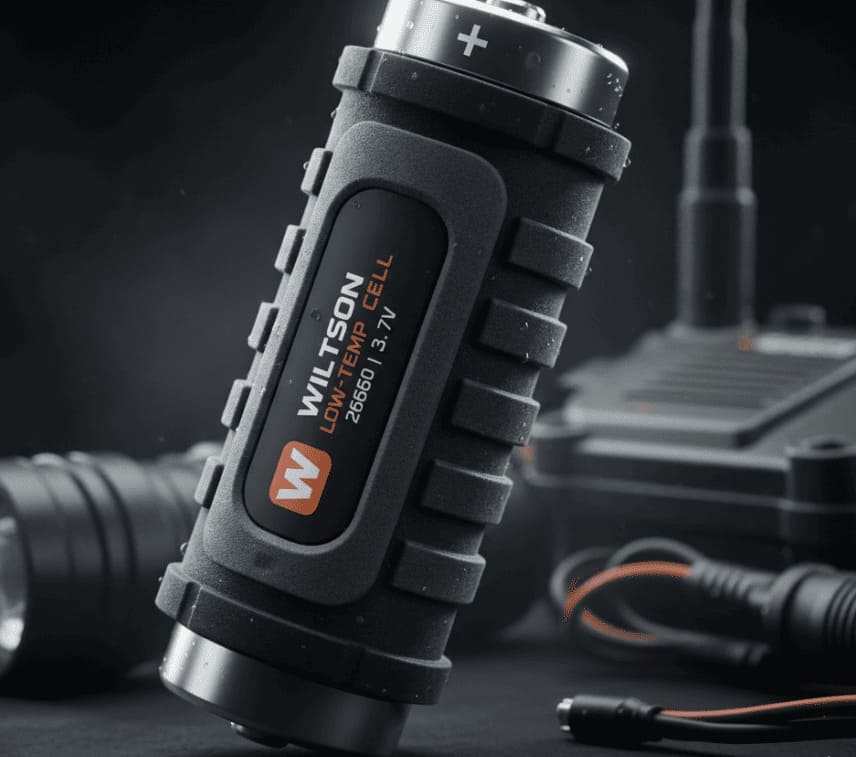
Wiltson's Low-Temperature 26650 Solution
Wiltson's 26650 low-temperature cells combine the mechanical advantages of the cylindrical format with advanced electrolyte chemistry designed for extreme cold operation. Key specifications include:
Operating temperature range: -40°C to +60°C (-40°F to +140°F)
No heating required: Eliminates thermal signature and EMI
Instant start-up: Zero pre-heat latency
Design aligned with MIL-STD-810G: Low-temperature performance testing methodology
Technical Comparison: Heated vs. Non-Heated Systems