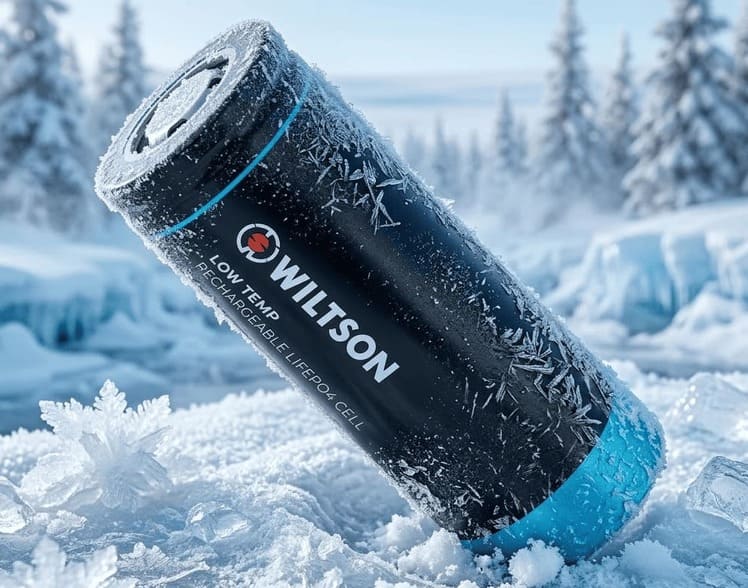
At 4:30 AM on a sub-zero winter morning, your remote asset is at its most vulnerable. The battery is at its lowest state of charge, temperatures have hit their daily minimum, and the "winter heater" you paid extra for has just drained the last 20% of your reserve capacity.
The Heater Trap
A parasitic load that guarantees failure exactly when you need reliability most. For a municipal street light or a remote security camera, one winter failure doesn't just mean a dark pole—it means a $1,500 emergency dispatch, lost data continuity, or a security blind spot.
Standard LiFePO4 batteries retain only 30-40% capacity at -20°C and cannot safely charge below 0°C due to lithium plating. Low-temperature variants solve this through specialized electrolyte formulations and validated BMS charging curves, enabling direct solar charging at -30°C and reliable discharge at -40°C without external heating.
This guide maps the three technical failure modes that attack outdoor power systems in winter, and shows how heater-free low-temp LiFePO4 addresses each.
Understanding the Three Winter Failure Modes
Cold-weather battery failures don't happen randomly. Most outdoor infrastructure fails in one of three ways:
1Winter Energy Budget Collapse
The Problem: Short winter days reduce solar input while nighttime loads remain constant. Standard LFP locks out charging below 0°C, so even on sunny winter days, the battery can't accept power. State of charge spirals downward until blackout.
The Mechanism: Lithium-ion intercalation kinetics slow dramatically below 0°C, causing irreversible lithium plating instead of charging.
Low-Temp LFP Solution
Validated algorithms allow controlled charging at -30°C. Electrolyte maintains ionic conductivity, and the BMS prevents plating while accepting critical winter solar input.
Affects: Solar street lights, LED billboards, weather stations.
2Voltage Sag Under Pulse Loads
The Problem: When a motor starts or an IR LED fires in the cold, the terminal voltage drops below the controller's undervoltage lockout threshold—even if the battery has charge. The system shuts down.
The Mechanism: Internal resistance doubles between 25°C and -20°C. During high-current pulses, the voltage drop (V = I × R) triggers brownouts.
Low-Temp LFP Solution
Optimized electrode architecture maintains lower internal resistance at sub-zero temperatures. Can deliver 3C-5C pulse currents at -30°C while keeping terminal voltage stable.
Affects: Solar trackers, security cameras, PTZ equipment.
3Long-Term Unmanned Reliability Failure
The Problem: Maintaining data continuity and reliable wake-up over months without maintenance. A single missed charging cycle or communication dropout compromises the deployment's value.
The Mechanism: High self-discharge during dormancy, inability to accept trickle charging, and cumulative capacity fade from repeated cold-temperature cycling.
Low-Temp LFP Solution
Ultra-low self-discharge (1-2% monthly), validated sub-zero trickle charge acceptance, and superior cycle life (2,000+ cycles at -20°C vs.<500 for standard cells).
How low-temperature LiFePO4 compares to other battery technologies considered for cold climates.
Low-Temp LFP vs. Sodium-Ion▼
Na-Ion Advantages: Lower material costs, good low-temperature discharge performance.
Critical Limitations: Lower energy density (90-150 Wh/kg), shorter cycle life (1,000-2,000 cycles), and crucially, sodium-ion still faces charging restrictions below 0°C due to plating risks.
Bottom Line: For scenarios where winter solar charging is critical, low-temp LFP's validated -30°C charging capability is irreplaceable.
Low-Temp LFP vs. Heated Standard LFP▼
Why It Fails: The heater is a parasitic load consuming 15-50W continuously. A 30W heater running 12 hours consumes 360Wh—often more than a small solar panel generates in a winter day.
The Hidden Cost: Adds wiring complexity, increases enclosure size, and creates a single point of failure. If the heater dies, the battery dies.
Bottom Line: Low-temp LFP has zero parasitic load. Every watt-hour of solar generation goes to your application.
Low-Temp LFP vs. Lead-Acid (AGM/Gel)▼
Lead-Acid Reality: Loses 50%+ capacity at -20°C, requires 2-3x oversizing, weighs 3-4x more, and only lasts 300-500 cycles.
Total Cost of Ownership: Combination of oversizing, short lifespan, and maintenance makes it 2-3x more expensive over a 5-year deployment.
Bottom Line: Only makes sense for very low-budget projects with extremely easy maintenance access and no weight/volume constraints.
Engineering Considerations: System Design
Validated Charging Curves
You cannot simply change BMS parameters on standard cells to charge at -30°C. True sub-zero charging requires cell-level electrochemical validation, reduced charging rates (0.1C-0.3C), and temperature-compensated voltage limits.
Specify batteries with documented low-temperature charging test data, not just marketing claims.
System Sizing for Winter
Many integrators mistakenly size based on summer performance. You must calculate worst-case winter solar input, size for 3-5 days of autonomy, and account for temperature derating.
Rule of Thumb: If your summer system has 1 day of autonomy, you need 3-4x that capacity for reliable winter operation.
The Thermal Management Paradox
Low-temp LFP eliminates the need for active heating, but passive thermal management still matters. Use insulated enclosures, leverage the battery's thermal mass, and avoid mounting directly to metal heat sinks. In extreme -40°C climates, minimal 5-10W supplemental heating is vastly superior to the 30-50W required for standard LFP.
Selection Framework
Use this decision tree to validate that low-temp LFP is the right solution for your failure mode:
1
Does your system have solar charging in winter?
YES: Low-temp charging capability (-30°C) is critical. Standard LFP with heaters will fail. NO: You may only need low-temp discharge capability.
2
What is your primary load profile?
• Steady loads (lighting): Focus on winter solar acceptance & eliminating heater loads. • Pulse loads (motors, PTZ): Focus on internal resistance and burst current at temp. • Low power (sensors): Focus on self-discharge and wake-up stability.
3
What is your maintenance access?
Remote/Expensive: Low-temp LFP's reliability justifies higher upfront cost. Easy/Cheap: You might consider lead-acid if space and weight are unlimited.
The Business Case: Total Cost of Ownership
Low-temp LFP costs 1.5-2x more upfront, but delivers drastically lower TCO.
Avoided Costs
No heater hardwareSave $50-200
No heater energy costSave 80-160 kWh/5yrs
Smaller solar panels15-25% reduction
Fewer truck rollsSave $800-1,500/call
Lifespan & ROI
• Low-temp LFP: 5-8 year field life (2,000+ cycles at -20°C)
• Heated Standard LFP: 3-4 year field life (thermal stress)
Typical Payback Period: 2-3 Years
Next Steps: From Evaluation to Deployment
Ready to Specify
Send us your site coordinates and load profile. We'll provide a custom sizing report and BOM.
The fundamental insight behind heater-free low-temperature LiFePO4 is simple: it's cheaper and more reliable to work with winter than to fight it.
Standard batteries try to create a tropical microclimate inside an insulated box, burning precious energy to maintain 0°C while the world outside sits at -30°C. This violates basic thermodynamics—you're fighting an uphill battle against heat loss, and in a solar-powered system with limited winter energy budget, you cannot win.
Low-temp LiFePO4 takes the opposite approach: accept that the battery will be cold, and engineer the electrochemistry to work at that temperature. The technology is proven. The economics are compelling. Will your next deployment repeat the mistakes of the past, or embrace a solution designed for reality?