



Learn how cold weather affects batteries in Utah and discover best practices and battery technologies that maintain reliable power for EVs, solar systems, and off-grid applications.
Why Cold Weather Drains Battery Performance
Utah’s winters combine high-altitude cold snaps, rapid day-night swings, and prolonged sub-zero periods in mountain regions. In these conditions, most battery chemistries experience the same physics-driven bottlenecks:
-
Electrolyte viscosity increases as temperature drops. Thicker electrolyte slows ion transport between electrodes.
-
Ion mobility declines in both cathode and anode, elevating polarization and reducing usable voltage under load.
-
Internal resistance (IR) rises, which increases voltage sag and heat generation during discharge while lowering available power.
-
Lithium plating risk emerges when charging lithium-based chemistries below ~0 °C without heating—metallic lithium can deposit on the anode, permanently degrading capacity and safety margins.
What users observe in the field:
At −20 °C to −30 °C, conventional Li-ion packs can lose a large fraction of their nominal capacity and struggle to deliver peak current for motor starts or inverter surge loads. Solar homes see earlier low-voltage cutoffs overnight; EVs show reduced range; remote sensors may brown out before dawn.
Best Battery Chemistries for Cold Environments
LiFePO₄ (Lithium Iron Phosphate)
For cold-state use (Utah, Alaska, Canadian Rockies), LiFePO₄ is the workhorse due to its thermal stability, flat discharge curve, and long cycle life. While LiFePO₄ also loses capacity in the cold, it tolerates discharge at very low temperatures better than many layered-oxide cells. When paired with pre-heating or heated BMS for charging, it becomes a reliable all-season platform.
Key takeaways for Utah:
-
Excellent safety profile and cycle life.
-
Predictable behavior at −20 °C to −40 °C for discharge (with reduced capacity).
-
Charging below 0 °C requires pre-heating or a low-temp BMS heater.
Li-ion (Layered Oxides like NMC/NCA)
High energy density but more sensitive to cold charging and high-current discharge at sub-zero temps. Suitable if the pack is insulated and actively heated prior to use/charge.
NiMH
Moderate low-temp tolerance and robust safety, but lower energy density and higher self-discharge than Li chemistries. Useful for small devices where energy density is less critical.
Lead-Acid (AGM/Gel)
Budget-friendly and familiar, but heavy with lower usable capacity in the cold. Internal resistance rises sharply; high-current performance suffers. Best for stationary backup where cost is the dominant constraint and weight/volume are acceptable.
BMS Intelligent Heating
For lithium chemistries, BMS-integrated heaters or heating films protect cells during cold charging, bringing the core temperature above 0 °C before accepting charge. In Utah winters, a low-temperature BMS is often the difference between longevity and early degradation.
Practical Applications in Utah
Solar Cabins & Off-Grid Homes (Park City, Heber Valley, Logan Canyon)
Nighttime lows below −20 °C can collapse available capacity just when loads peak (lighting, HVAC fans, pumps). Low-temp LiFePO₄ with insulated enclosures and a pre-heat routine preserves overnight autonomy and reduces generator runtime.
EVs on Snowy Mountain Roads (Wasatch Front, Big/Little Cottonwood Canyons)
Cold-soaked packs show reduced power and range. Thermal preconditioning (garage charging with pack warming, departure scheduling) restores usable energy and acceleration; low-temp-rated aux batteries support winches, lighting, and accessories.
Telecom / IoT in Rural or Remote Sites (Uinta Mountains, high desert plateaus)
Unattended sites need predictable winter behavior. Low-temp LiFePO₄ packs with conservative low-voltage cutoffs and scheduled daytime charging windows maintain link uptime even during blizzards.
Quick selection matrix
| Use Case (Utah) | Recommended Chemistry | Operating Temp Focus | Pack Notes / Capacity Guidance |
|---|---|---|---|
| Solar cabin overnight | LiFePO₄ (low-temp) | Discharge down to −30 °C | 1.2–1.4× summer capacity; insulated box |
| EV auxiliary / accessories | LiFePO₄ (low-temp) | Rapid current at −10 ~ −20 °C | Pre-heat before charge; surge-ready BMS |
| Telecom/IoT remote | LiFePO₄ or NiMH | Long idle at −20 ~ −30 °C | Scheduled charge; low-temp LVC strategy |
| Budget stationary backup | AGM/Gel | Limited cold performance | Capacity derating; frequent top-ups |
Tips for Using Batteries in Cold Weather
-
Storage temperature & SOC: For long layovers, store between −20 °C and +25 °C when possible, at 30–50% SOC. Avoid full charge storage in the cold; it accelerates aging once temperatures rise.
-
Charging below 0 °C: Do not charge most lithium chemistries below 0 °C without a pre-heat routine. Use a heated BMS or a thermostat-controlled pad to bring cell cores above freezing.
-
Enclosure design: Insulate packs; add small, controlled heating (5–20 W per kWh as a rule-of-thumb) and maintain airflow for safety. Avoid condensation with breathable membranes or desiccant packs.
-
Cables & terminations: Cold stiffens insulation and increases contact resistance. Use properly rated conductors and torque specs; re-check terminations mid-winter.
-
System setpoints: Raise low-voltage cutoffs slightly in deep winter to avoid excessive voltage sag under surge loads.
Case Study: IFR26650LT Performance in Utah Winter
Context: A Wasatch-range cabin retrofitted from AGM to low-temp LiFePO₄ cells for winter autonomy. The pack uses IFR-format LiFePO₄ cells designed for sub-zero discharge.
Relevant cell metrics (IFR26650LT):
-
Discharge window: −40 °C to +60 °C (cell-level)
-
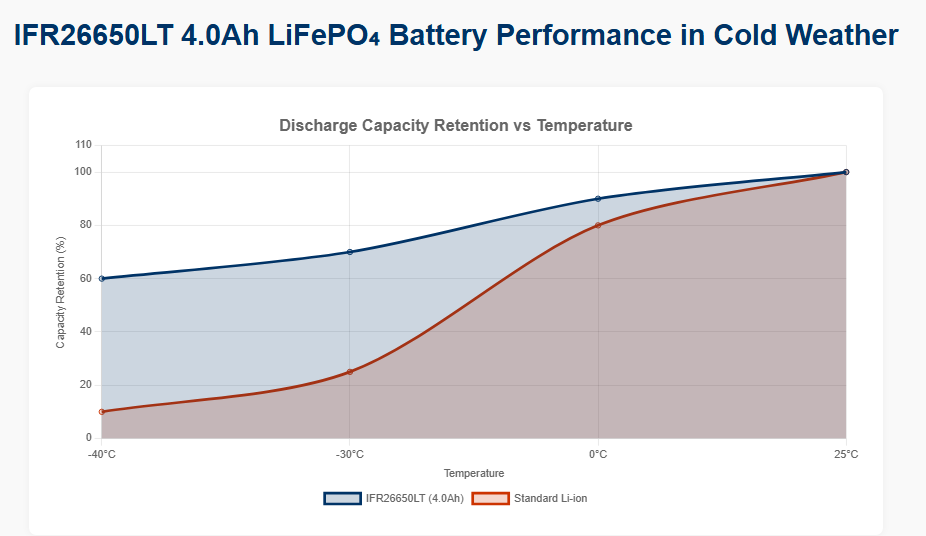
Capacity retention: ≥ 70% at −30 °C; ≥ 60% at −40 °C (discharge)
-
Cycle life: ≥ 2000 cycles at 25 °C, 80% DOD
-
IR spec: ≤ 25 mΩ (AC 1 kHz) at room temperature
System behavior observed in winter:
-
Overnight autonomy: With enclosure insulation and passive heat retention, the cabin maintained lighting/communications without early low-voltage cutoffs.
-
Morning charge session: BMS heater raised cell temps to safe charge thresholds; solar input resumed without lithium plating risk.
-
Surge loads: Inverter start-ups showed lower voltage sag compared to the prior AGM bank, reducing nuisance trips.
What the curves show
-
Capacity vs temperature (−40, −30, 0, 25 °C): Relative capacity descending from ~100% at 25 °C to ≥ 60% at −40 °C for the low-temp LiFePO₄; steeper decline for standard Li-ion reference cells.
-
IR vs temperature: Monotonic rise with decreasing temperature; the low-temp cell curve sits below the reference, reflecting better sub-zero conductivity under load.
Buying Guide: Choosing a Cold Weather Battery in Utah
Key factors
-
Capacity & Voltage: Size for winter, not summer. Consider a 20–40% winter margin to absorb cold-weather derating and higher nighttime loads.
-
Low-temp discharge rating: Verify tested discharge performance at −20 °C, −30 °C, and (if relevant) −40 °C, not just a nominal “operating range.”
-
Charge strategy: Ensure the pack or BMS supports pre-heating before charge below 0 °C. This is essential for lithium longevity and safety.
-
Cycle life & warranty: Cold cycling is harsher; look for ≥ 2000-cycle ratings at standard conditions, with clear winter usage guidance.
-
Safety & compliance: Seek UN38.3 and IEC 62133 compliance at the cell/pack level, along with enclosure ingress protection (e.g., IP65 for outdoor boxes).
Standards to look for
-
UN38.3: Transport safety compliance—vibration, shock, thermal, altitude, short-circuit testing.
-
IEC 62133: Safety for portable sealed cells and batteries—overcharge, external short, mechanical abuse.
Model example
-
IFR26650LT (LiFePO₄):
-
Discharge to −40 °C, ≥ 70% at −30 °C and ≥ 60% at −40 °C
-
≥ 2000 cycles at 25 °C, 80% DOD
-
Well-suited for solar cabins, EV auxiliaries, telecom/IoT with proper heated-charge management.
Conclusion
Utah’s winter climate exposes the weak links in ordinary energy storage: electrolytes thicken, ions slow down, internal resistance climbs, and available capacity shrinks—precisely when you need power the most. The path to resilience is both chemistry-based and system-level:
-
Choose a cold-ready chemistry (low-temp LiFePO₄) with proven sub-zero discharge data.
-
Deploy pre-heating or heated BMS to protect charging below freezing.
-
Right-size capacity for winter derating, insulate enclosures, and tune setpoints for cold surges.
Follow these practices and your solar cabin, EV accessories, or remote telecom site will keep running through Utah’s sub-zero nights—reliably and safely.